
Magi: The Labyrinth of Magic
The Arabian Nights reimagined as sweeping shonen adventure: dungeon-conquering, bottled djinn and empire-building. Lavish, big-hearted fantasy.
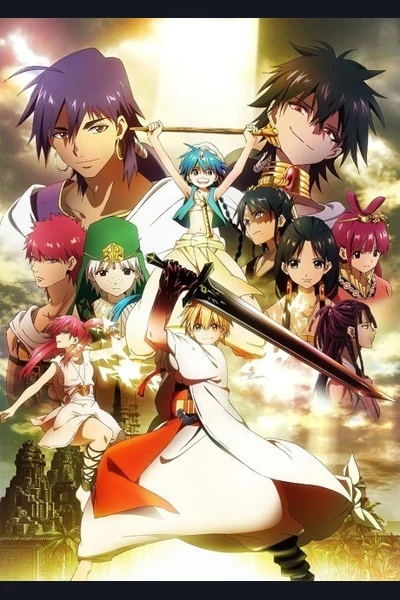
Small, cheerful Aladdin travels with a flute containing the enormous djinn Ugo. He befriends Alibaba Saluja, a young man with royal-sized ambitions and servant-sized finances, and proposes they conquer a mysterious dungeon. Treasure awaits inside, alongside traps designed by architects who regarded accessibility regulations as a personal weakness.
Overview
Shinobu Ohtaka's manga borrows names and imagery from One Thousand and One Nights to construct an original battle-fantasy world. Aladdin is a Magi, a magician able to guide potential kings. Alibaba seeks power to change society, while former slave Morgiana fights to claim freedom and a future beyond what was done to her.
Dungeons and djinn equip the early adventure, but the story soon expands into trade, empire, revolution and competing systems of magic. The golden rukh that surround living things become both spiritual language and political resource.
Why it matters
Magi gives battle-manga escalation a political imagination. Heroes do not simply defeat tyrants and leave before bin collection resumes; they confront poverty, slavery, conquest and the compromises of governing. Alibaba's difficulty converting good intentions into institutions is more interesting than another effortless throne.
The friendship among Aladdin, Alibaba and Morgiana supplies the emotional centre. Their different experiences prevent the grand argument about fate from floating entirely into the clouds.
What to expect
Expect colourful dungeons, large battles, magic systems, comedy and an increasingly complicated map of nations. Slavery, war, massacre, discrimination and sexualised humour sit beneath the bright designs. Morgiana's story carries real force, though female characters do not always escape the genre's decorative habits.
The series draws broadly from Middle Eastern, South Asian and other cultures rather than representing a precise historical society. Its exuberant mixture can inspire curiosity, but it should not be mistaken for a cultural guidebook with genies added.
Adaptations and versions
The completed manga is the only route through the full central story. A-1 Pictures' anime covers major early material across The Labyrinth of Magic and The Kingdom of Magic, changing and compressing some events before stopping well ahead of the manga's conclusion.
Magi: Adventure of Sinbad is a prequel centred on the charismatic king Sinbad. It adds context but works better after the main series has introduced the man whose legend it is busily polishing.
Where to start
The anime is an attractive introduction with strong music and energetic spectacle. Move to the manga—or begin there—if you want the complete political and cosmological journey. Starting from volume one avoids adaptation seams.
Verdict The SFcrowsnest take
Magi begins with a boy, a flute and a treasure dungeon, then discovers entire economies waiting behind the door. Its reach occasionally exceeds its grasp, but big-hearted ambition is preferable to another corridor of interchangeable monsters. Bring a map, distrust empires bearing infrastructure and give Morgiana the room she has earned.