
The Seven Deadly Sins (Nanatsu no Taizai)
A princess recruits a band of disgraced legendary knights to reclaim her kingdom; big, brash, crowd-pleasing fantasy adventure with a hefty global following.
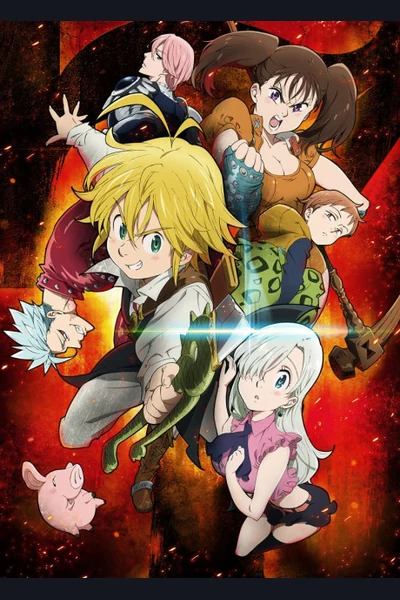
Seven legendary knights have been framed, scattered and converted into tavern gossip. Princess Elizabeth needs them back before the kingdom of Liones completes its slide from constitutional difficulty into armoured coup. Fortunately, their captain Meliodas runs a travelling pub on the back of an enormous green pig. Medieval government has seen worse recruitment drives.
Overview
Nakaba Suzuki's manga began in 2012 and builds a bright, muscular fantasy from Arthurian names, holy knights, demons, magical weapons and power levels liable to require their own air-traffic controller. Each Sin bears the mark of a supposed crime and the personality of someone who has had years to make peace with notoriety—or to avoid doing so with considerable energy.
The immediate pleasures are simple: a likeable party, broad comedy, mysteries in the heroes' pasts and battles that grow steadily less respectful of local property values. Underneath sits a story about guilt, prejudice and whether a public reputation can become a prison.
Why it matters
The series became one of the internationally prominent fantasy adventures of the streaming era, offering a complete long-form quest without requiring prior knowledge of a larger franchise. Its best asset is the group itself. Ban, King, Diane, Gowther, Merlin and Escanor are not merely differently coloured attacks waiting in a row; their loyalties and private damage give the campaign its emotional machinery.
It is also an example of battle manga's gift for turning European myth into a cheerful cultural jumble. Arthurian scholarship may wish to sit down before proceeding.
What to expect
Expect sword fights, transformations, tournament logic, tragic backstories and comic reversals. The tone can jump from operatic sorrow to a pig complaining about the catering without applying the brakes.
Prospective readers should know that its sexual humour is frequently tiresome. Meliodas's repeated groping is treated as a running gag, and the series' treatment of bodies and age-coded appearances can make otherwise buoyant material distinctly uncomfortable. Violence, death, demons and coercive relationships also place this well beyond a harmless children's romp, whatever the colourful surface suggests.
Adaptations and versions
The manga is the source and provides the most consistent route through the full story. The television anime began under A-1 Pictures, with later production moving elsewhere; changes in schedule and studio are visible in the animation, occasionally from the next postcode.
There are also films, specials and a sequel generation. These are additions rather than sensible entry points, and similarly named streaming listings deserve a careful glance before pressing play.
Where to start
Begin with manga volume one if you want stable artwork, clean continuity and the completed central tale. The first anime series is a brisk, accessible sampler for anyone who prefers voices, music and airborne masonry.
Verdict The SFcrowsnest take
At its best, The Seven Deadly Sins is a generous pub meal of a fantasy: oversized, comforting and served with a weapon embedded in the table. Its fellowship has real charm and its mythology knows how to keep a secret. The stale sexual comedy is a meaningful reservation, not a decorative footnote, but readers able to tolerate it will find a boisterous quest with more heart than its decibel level initially implies.