
Fullmetal Alchemist: Brotherhood
Two brothers pay a horrific toll for breaking alchemy's single golden rule; routinely and correctly named among the finest things the medium has produced.
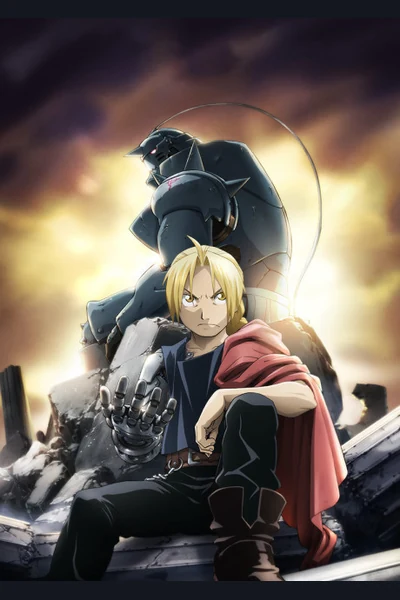
Brothers Edward and Alphonse Elric attempt to resurrect their dead mother using alchemy. The experiment fails. Edward loses an arm and leg; Alphonse loses his entire body and survives with his soul bound to armour. Equivalent exchange, alchemy's governing principle, has supplied an answer in the manner of a loan shark interpreting small print.
Hiromu Arakawa's Fullmetal Alchemist manga ran in Square Enix's Monthly Shonen Gangan from 2001 to 2010 and filled 27 volumes. Bones produced two major anime versions: Fullmetal Alchemist in 2003, which developed an original story after catching the manga, and Fullmetal Alchemist: Brotherhood in 2009, which follows Arakawa's completed plot more closely. The title page says Brotherhood, but understanding the property requires acknowledging both rather than quietly sending the first adaptation to storage.
Overview
Edward becomes a State Alchemist to gain access to research and resources that might restore the brothers' bodies. This places them inside the military government of Amestris, where alchemy functions as science, weapon and state credential. Their search for the Philosopher's Stone reveals war crimes, conspiracies and the human material concealed beneath national progress.
Edward is brilliant, furious and sensitive about his height. Alphonse, despite being a towering empty suit of armour, is the gentler presence. Their relationship gives the story its moral centre. Each would sacrifice himself for the other; maturity requires learning why this is not always a solution.
Why it matters
Arakawa constructs one of manga's most satisfying long plots. Early comic details, supporting characters and political facts return with purpose. Soldiers, mechanics, teachers, refugees and civil servants contribute to the ending; power does not collapse into a private duel while everybody else waits beyond the panel.
Alchemy provides a rigorous metaphor for knowledge and consequence. The series respects science without assuming knowledge makes its user wise. Human transmutation, military research and the Philosopher's Stone all ask the same question: who pays when ambition declares a cost acceptable?
The treatment of war and Ishvalan persecution gives the adventure weight. The story condemns genocide while allowing characters implicated in the state to seek accountability and repair. Not every element is equally nuanced, but the refusal to solve institutional crimes with a single defeated villain remains notable.
What to expect
Expect adventure, conspiracy, body horror, war, bereavement and generous comedy. The tonal transitions can be abrupt, particularly the exaggerated jokes around Edward's height, yet the humour prevents darkness from becoming prestige sludge. Violence is serious without being relentlessly graphic. Romance is understated and founded on trust rather than decorative misunderstanding.
Arakawa's women are unusually well served for the genre: soldiers, engineers, teachers and leaders with goals independent of supporting the nearest boy. The cast is large but disciplined, each character occupying a place in the social and thematic machinery.
Adaptations and versions
The manga is the definitive source. The 2003 anime begins from the same premise but becomes a darker alternate interpretation with different mythology and ending; the film Conqueror of Shamballa concludes that continuity. It deserves to be judged as an adaptation with its own argument, not a failed rehearsal.
Brotherhood moves quickly through early material already adapted in 2003, then settles into a faithful and comprehensive version of the manga. Its first episodes can feel compressed, but the long structure pays off. The Sacred Star of Milos is an optional side film. Live-action films form another separate adaptation and are not required.
Where to start
For one screen version, choose Brotherhood. For the fullest experience, read the manga. Watch the 2003 series separately afterwards if interested in how the same premise can produce a different tragedy. Do not alternate episodes between versions unless confusion is the intended Philosopher's Stone.
Verdict The SFcrowsnest take
Fullmetal Alchemist earns its reputation through construction rather than fashion. It joins intimate guilt to national crime, gives its supporting cast meaningful work and reaches an ending that answers the questions it asked without pretending the dead were merely a bookkeeping error.
Brotherhood is the recommended anime, the manga the finest whole and the 2003 series a worthwhile alternate path. Intelligent, humane and exceptionally complete, it belongs near the front of the trophy cabinet—well away from anybody drawing a transmutation circle on the floor.