
One Piece
A rubber-bodied optimist hunts the world's greatest treasure across a thousand-plus episodes; the best-selling comic ever printed and a lifestyle commitment.
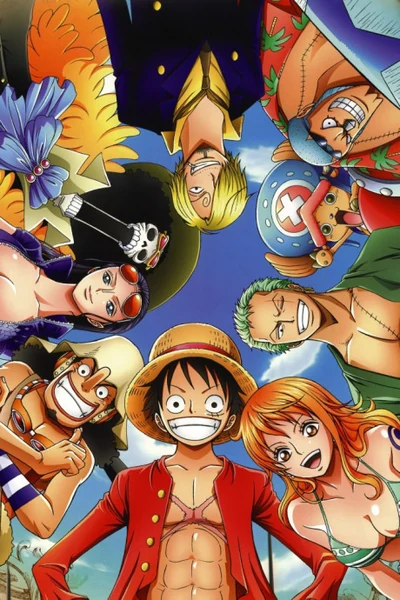
Monkey D. Luffy wants to become King of the Pirates by finding the One Piece, a treasure left by the executed Pirate King Gol D. Roger somewhere beyond the reasonable limits of serial publication. Luffy cannot swim, which is a drawback in maritime employment, but has a body that stretches like rubber after eating a mysterious Devil Fruit. He also possesses absolute faith in his friends, no measurable fear of authority and the strategic planning instincts of a Labrador entering a butcher's shop.
Eiichiro Oda's manga began in Shueisha's Weekly Shonen Jump in 1997 and has grown into one of the largest and most successful continuing stories in comics. Toei Animation's television adaptation began in 1999. Films, games, novels, stage productions, a live-action television adaptation and enough merchandise to ballast a navy have followed. The intimidating length is real. So is the reason people keep going.
Overview
Luffy assembles the Straw Hat Pirates while travelling through the Grand Line, a sea route where climate, geography and common sense have agreed to pursue separate careers. The crew includes swordsman Zoro, navigator Nami, sniper Usopp, cook Sanji, doctor Chopper, archaeologist Robin, shipwright Franky, musician Brook and helmsman Jinbe. Each arrives with a dream, a wound and at least one visual characteristic capable of supporting a toy range.
The journey moves from island to island, allowing Oda to construct new societies with their own rulers, economies, species, injustices and local absurdities. A bright adventure may become a story about slavery, censorship, famine, racism or inherited political violence without ceasing to contain a talking skeleton asking to see somebody's underwear. Tonal dignity is not enforced at the border.
Devil Fruits grant strange powers while removing the ability to swim. Haki provides another system of will and perception. Neither matters as much as Oda's talent for turning ridiculous abilities into tactical problems. A power that sounds useless during explanation may become formidable once given to somebody with imagination and several hundred chapters of unresolved business.
Why it matters
Oda's great achievement is cumulative world-building. Early jokes become historical clues. A minor name can return years later attached to major consequences. Institutions—the Marines, World Government, Revolutionary Army, pirate emperors and assorted kingdoms—overlap across arcs until the voyage feels less like a sequence of destinations than a world continuing beyond the panel.
This would be hollow without the crew. One Piece is fundamentally a found-family story about people whose original homes failed them. Luffy rarely asks for a respectable past. He identifies the dream somebody cannot pursue alone and treats assistance as settled. His emotional intelligence is peculiar but precise: he may not understand the politics, yet knows when a friend is being made to deny what they want.
The politics grow sharper beneath the cartoon surfaces. Oda distrusts inherited authority, official history and systems that declare people disposable. Pirates can be villains, liberators or idiots; Marines can be honourable, brutal or trapped inside the institution. The series does not offer a tidy anti-government pamphlet. It offers a long argument that legitimacy without compassion is merely a flag above a locked door.
What to expect
Expect enormous adventure, broad comedy, emotional flashbacks, stylised combat and occasional stretches in which everybody is running towards the next important location. Violence is frequent but generally less graphic than modern dark fantasy. Death, enslavement, abuse and war appear, sometimes beneath designs so cheerful that parental judgement should not be outsourced to the colour palette.
The comedy is elastic, shameless and repetitive by design. Character habits recur for decades. Sanji's behaviour around women can be tiresome; female character designs become notably narrow in range despite the variety elsewhere; certain arcs expand beyond their ideal length. Loving One Piece does not require signing a waiver against criticism. It merely requires accepting that excess is the native climate.
Romance is peripheral within the main crew. Loyalty and dreams are the central relationships. The emotional peaks are sincere enough to make readers cry over ships, whales and other objects that previously appeared safely outside the jurisdiction of heartbreak.
Adaptations and versions
The manga is the source, the most economical version and the best way to appreciate Oda's layouts and background detail. It remains long, but reading moves faster than broadcast anime and avoids pacing designed not to overtake a weekly comic. Official colour editions exist in some markets and formats, though English availability should be checked.
Toei's anime adds famous performances, music and expanded action. Its weakness is pacing: later episodes may adapt relatively little manga, stretching reactions and movement until time itself appears to have eaten a Devil Fruit. A revised anime adaptation titled The One Piece, produced by Wit Studio, has been announced; confirm its release status before publication.
The films are mostly optional and vary in continuity, though later productions involve substantial design input from Oda. Netflix's live-action series offers a compressed, affectionate alternative introduction. It changes events and cannot replace the full journey, but it proves that the material can survive contact with human knees.
Where to start
The best route is manga volume one. Read through the East Blue material and at least reach the Arlong Park arc before deciding whether the series has earned your time; that is where its mixture of comedy, injustice and emotional commitment becomes unmistakable. The anime works if you prefer performance, but patience will eventually become a crew member.
Avoid random highlight clips and late arcs as an entry point. One Piece cashes emotional cheques written hundreds of chapters earlier. Starting near the current material is like attending a family wedding halfway through the speeches and wondering why the skeleton has a violin.
Verdict The SFcrowsnest take
One Piece is not simply long. It is cumulative. Oda uses duration to make islands into history, jokes into promises and a collection of eccentrics into one of popular fiction's great found families. The series can be indulgent, repetitive and structurally incapable of leaving a new character undesigned. It is also generous, politically alert and capable of delivering emotional consequences with terrifying accuracy.
The manga is the recommended vessel; the anime is the scenic route with occasional signal delays. Either way, this is less a title to finish than a world to inhabit. Pack lightly. The crew will acquire everything else, including several national emergencies and a heartbreaking relationship with a boat.