My Hero Academia
In a world where almost everyone has a superpower, the one powerless boy inherits the strongest of the lot; essentially the X-Men via Shonen Jump.
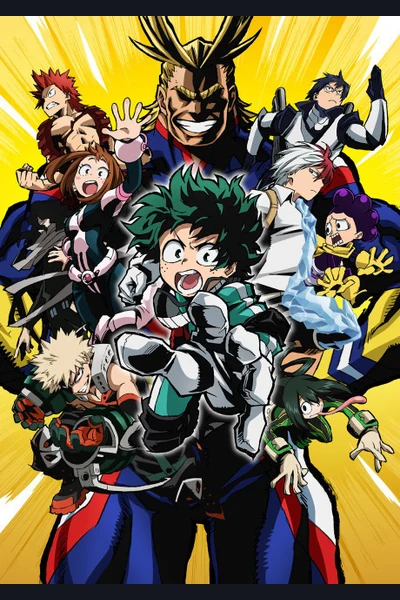
Izuku Midoriya lives in a world where most people possess a superhuman Quirk. He has none, which is unfortunate because he has spent his childhood studying heroes with the concentrated enthusiasm of a future regulator. Then the world's greatest hero, All Might, sees Izuku run towards danger when qualified professionals hesitate and offers him One For All, an inherited power of such strength that using it initially breaks Izuku's bones. Superhero mentoring does not always begin with an adequate risk assessment.
Kohei Horikoshi's manga ran in Shueisha's Weekly Shonen Jump from 2014 to 2024. Bones adapted it into a long-running television anime beginning in 2016, supported by films, original episodes and spin-offs. The series blends Japanese school battle manga with American superhero imagery, then asks what happens when public safety depends upon celebrity rankings and one smiling man pretending never to be tired.
Overview
Izuku enters U.A. High School alongside students whose Quirks range from explosive sweat to detachable earlobes. His classmates include the furious Katsuki Bakugo, gravity-defying Ochaco Uraraka and Todoroki Shoto, whose divided fire-and-ice power comes with a family history requiring considerably more than careers guidance.
The school structure provides training exercises, tournaments, internships and exams, while villains expose the society beyond campus. All Might's declining strength makes succession urgent. Izuku must learn that possessing heroic power is different from understanding how, when and for whom to use it.
Why it matters
Horikoshi's great strength is character design. Quirks shape bodies, personalities, careers and public expectations. A power can be useful, embarrassing, marketable or socially stigmatised. The resulting society feels built around superhuman difference rather than decorated with it.
The series also examines heroism as labour and spectacle. Professional heroes need licences, agencies and approval ratings. Rescue competes with branding. Villains often emerge from failures the respectable system preferred not to see. The critique is not revolutionary—U.A. remains a school training better professionals—but it gives the battles moral context beyond stopping a person with alarming hands.
Izuku's defining trait is analysis rather than inherited might. His notebooks and muttered observations let him solve problems before his body can survive the solution. The story is strongest when kindness, rescue and tactical intelligence matter as much as victory. It weakens when its enormous cast competes for relevance or when late escalation compresses consequences that deserved more air.
What to expect
Early material is bright school adventure with bruising combat. Later arcs become darker, involving terrorism, child abuse, social collapse and serious injury. Comedy, friendship and school life remain, but the series does not stay inside the safe training ground advertised by the uniforms.
Romance is gentle and secondary. Rivalries and mentorship dominate. Bakugo's aggression is deliberately difficult, and the story's handling of his growth will matter greatly to individual viewers. Bones delivers expressive character animation and major action peaks, though consistency varies across a production of this length.
Adaptations and versions
The completed manga is the direct route and gives Horikoshi's increasingly detailed art full room. The anime follows the central story in seasonal order. Its feature films are designed to fit around the television continuity and are generally optional, though they provide polished action and character excursions.
Spin-off manga such as Vigilantes explore life outside the licensed hero system. They are not required before the main series. Check current adaptation status and film placement at publication; superhero chronology has enough capes without loose dates flapping among them.
Where to start
Begin with manga volume one or anime episode one. Continue the anime by numbered season, placing films only after the characters involved have appeared. The early sports festival is the proper extended test, revealing how well the series turns powers and personal histories into public competition.
Verdict The SFcrowsnest take
My Hero Academia begins as an affectionate answer to superhero comics and becomes an argument about the society built around them. It is sincere about rescue, suspicious of celebrity and generous with damaged children, although not always generous with page time.
Its crowded final movement cannot equal every superb beginning, but Izuku's central question survives: what makes somebody heroic before the power arrives? The answer is not the costume, ranking or punch. It is the decision to move towards a person in danger, followed, ideally, by better medical insurance.