
JoJo's Bizarre Adventure
Successive generations of impossibly muscular men strike elaborate poses and defeat evil with psychic ghosts; gloriously camp and utterly its own thing.
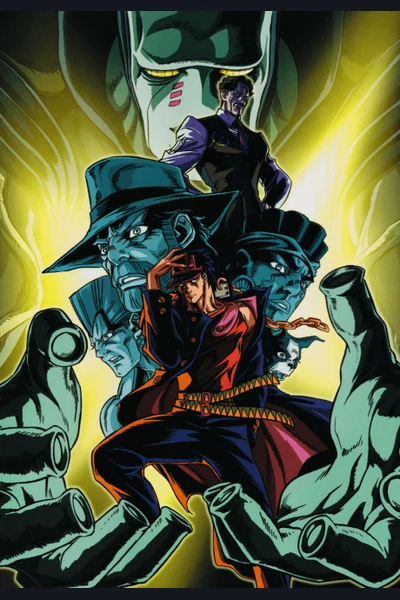
JoJo's Bizarre Adventure follows generations of the Joestar family as they confront vampires, assassins, serial killers, gangsters and supernatural abilities named after music Hirohiko Araki enjoys. The heroes change, the period moves forward and the clothing becomes progressively less willing to acknowledge conventional fastening.
Araki's manga began in Weekly Shonen Jump in 1987 and later moved to Ultra Jump. It is divided into Parts, each with a new setting, cast and central JoJo. David Production's television anime began in 2012 and adapts the Parts in order, finally making a sprawling cult manga relatively navigable without access to imported paperbacks and an annotated family tree.
Overview
Part One, Phantom Blood, establishes Jonathan Joestar and his adopted brother Dio Brando in Victorian melodrama involving a stone mask and weaponised breathing. Part Two, Battle Tendency, follows Joseph Joestar against ancient beings with magnificent physiques and no modest ambitions. Part Three, Stardust Crusaders, introduces Stands: psychic manifestations that become the franchise's defining battle system.
Later Parts shift to a Japanese town, the Italian criminal underworld, a Florida prison and alternate continuities. The format lets Araki reinvent the series without discarding its inheritance. A JoJo may be noble, devious or criminally entrepreneurial, but will eventually point with the full commitment of a Renaissance saint accusing somebody across a nightclub.
Why it matters
Stands transformed battle manga by making powers individual, symbolic and often peculiar. Victory depends less upon being strongest than understanding what impossible rule the opponent has brought into the room. A fight may concern time, zips, reflected damage or a condition activated when somebody looks over the wrong shoulder. Explanations are elaborate; conclusions are frequently ingenious.
Araki's visual evolution is equally important. Early bodies resemble heroic refrigerators. Later art draws upon fashion illustration, sculpture and increasingly fluid anatomy. His poses, sound effects and colour choices have influenced manga, games, fashion and an internet meme population now capable of independent government.
The series is camp without being insincere. Characters can wear heart-shaped cut-outs and still face grief with absolute conviction. Araki understands that extravagance and emotional seriousness are not enemies unless somebody has imposed a very dull dress code.
What to expect
Expect gore, body horror, animal deaths, elaborate strategy, sudden comedy and villains with operatic self-regard. Content varies by Part, but violence can be graphic and inventive. Romance is occasional; friendship, lineage and destiny are stronger forces.
The early Parts use Hamon martial arts before Stands take over. Viewers impatient for the famous system should not skip them: Jonathan and Joseph establish the family contrasts and Dio's importance. The anime's stylised colours and emphatic sound design suit the material perfectly.
Adaptations and versions
The manga is the complete and continuing source, though official English releases may trail Japanese publication. David Production's anime is the cleanest screen version: watch Parts One and Two in the first series, then Stardust Crusaders, Diamond Is Unbreakable, Golden Wind and Stone Ocean.
Earlier OVAs adapt portions of Stardust Crusaders with a darker tone and are best treated as an alternate version. Live-action material and games are optional. Always check which Part a release covers; the word bizarre has been granted wide operational authority.
Where to start
Start with Phantom Blood. It is short and more conventional than later JoJo, but supplies Dio, the Joestar inheritance and the series' commitment to melodrama. If it feels stiff, continue into Battle Tendency, where Joseph introduces mischief and the franchise discovers its hips.
Verdict The SFcrowsnest take
JoJo's Bizarre Adventure is not merely strange. It is rigorously strange, constructing rules beneath the poses and emotional continuity beneath generational reinvention. Not every fight is elegant and not every dog is treated humanely, but almost nothing feels focus-grouped.
The anime is an excellent entrance; the manga reveals Araki's astonishing evolution. Recommended for audiences who like tactical powers, horror, fashion and men explaining fatal supernatural clauses while arranged like expensive furniture. It is utterly itself, which after several decades may be the rarest Stand ability of all.