
Heidi, Girl of the Alps
Takahata and Miyazaki's pre-Ghibli warm-up that utterly conquered continental Europe; if you're of a certain age in Germany or Spain, this is your childhood.
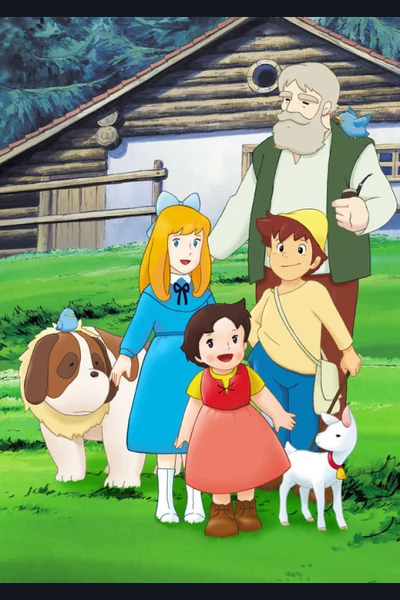
Orphaned Heidi is taken to live with her reclusive grandfather in the Swiss Alps. She discovers goats, mountains and an old man whose resistance to affection is less robust than advertised. Later she is sent to Frankfurt as companion to Clara, a wealthy girl unable to walk, and learns that clean drawing rooms can be more confining than a rough cabin with adequate sky.
The 52-episode anime adapted Johanna Spyri's novel in 1974. Isao Takahata directed, Hayao Miyazaki handled layout and scene design, and Yoichi Kotabe shaped character animation. Produced by Zuiyo Eizo, it helped lead into the World Masterpiece Theater tradition and offered a substantial rehearsal for the observational craft later associated with Studio Ghibli.
Overview
The series devotes time to daily life: herding goats, making cheese, learning a landscape and watching trust accumulate. Its drama comes from relationships and environment rather than villains. Even severe housekeeper Miss Rottenmeier is part of a social order rather than a weekly monster requiring Alpine combat.
Location research gave the mountains specificity. Weather, distance and labour matter. Heidi's happiness outdoors is not an abstract claim; the animation has shown the shape of her days.
Why it matters
Heidi became enormously popular across continental Europe, Latin America and elsewhere, sometimes more culturally familiar than in Britain or the United States. Dubs and repeated broadcasts made the Japanese adaptation part of local childhoods whose viewers did not necessarily know where it was animated.
Takahata's patience was radical in television animation. Ordinary movement and emotional development deserved screen time. Miyazaki's landscapes make freedom visible without turning nature into a tourism advert.
What to expect
Expect gentle family drama, homesickness, illness and separation. There is little violence. Younger children can follow it, though the slower pace differs from modern preschool editing and may require the dangerous skill of attention.
The treatment of disability reflects the nineteenth-century source and later adaptation choices; Clara's story should be discussed rather than treated as a simple moral cure.
Adaptations and versions
This is one among many Heidi adaptations, but its 52-episode length allows unusually full development. English availability is inconsistent; European-language editions are common. Verify whether a release is complete and uncut.
Where to start
Begin with episode one and allow several episodes for Alpine life to establish its rhythm. This is not a series improved by skipping to plot events. The goats have undertaken important preparatory work.
Verdict The SFcrowsnest take
Heidi, Girl of the Alps is warm without becoming shapeless and visually simple without being careless. It shows the future Ghibli masters learning how environment and daily routine can carry emotion.
An essential pre-Ghibli work and a reminder that animation history includes children watching clouds, not merely robots hitting one another through buildings.