
Frieren: Beyond Journey's End
An elf mage outlives her adventuring party and spends a millennium quietly working out what friendship was; melancholy has rarely looked this gorgeous.
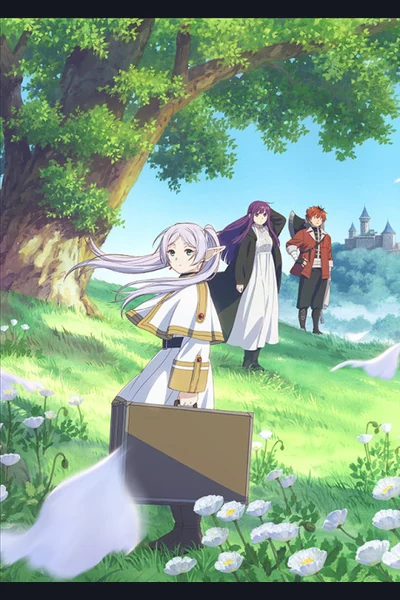
Most fantasies finish when the heroes defeat the Demon King. Frieren: Beyond Journey's End begins there, after the victory parade, when the surviving adventurers have received their statues and the clerical department has presumably closed the quest. Frieren, the party's elven mage, wanders away for what feels to her like a brief excursion. Fifty years later she returns to find her human companions old.
This is the problem with immortality: everybody else keeps making unreasonable scheduling decisions.
Written by Kanehito Yamada and drawn by Tsukasa Abe, Frieren began in Shogakukan's Weekly Shonen Sunday in 2020. Madhouse's anime adaptation began in 2023. The English subtitle Beyond Journey's End states the organising idea neatly. This is not a sequel to the adventure so much as an examination of what the adventure meant after one participant finally notices that ten years can be either a defining portion of a life or a pleasant interval between errands.
Overview
Frieren's original party included Himmel the Hero, Heiter the priest and Eisen the dwarf warrior. Their decade together occupies only a fraction of Frieren's long existence, and she assumes there will always be time to understand it later. Himmel's death reveals the error. She knew him for ten years and barely knew him at all.
Frieren begins retracing old routes and collecting trivial spells, accompanied first by Fern, a young mage raised by Heiter, and later by Stark, Eisen's anxious but formidable student. Villages have changed. Statues have weathered. Stories about the heroes have become civic furniture. Small encounters trigger memories that reveal what Himmel said or did, often without Frieren understanding its significance at the time.
The structure turns flashback into emotional archaeology. Himmel is absent but steadily becomes one of the story's most present characters. A gesture in the current journey uncovers its earlier counterpart; a ridiculous statue records vanity and kindness at once. Grief does not arrive as a single dramatic collapse. It accumulates as comprehension.
Why it matters
Fantasy regularly uses elves as attractive people with superior night vision. Frieren takes longevity seriously as a difference in perception. Frieren is not cold, exactly. Her sense of duration has made human urgency difficult to see. The story asks whether empathy can be learned after the opportunity for reciprocity has passed.
This gives ordinary fantasy objects unusual weight. A spell for making grapes sour or cleaning a statue may appear useless beside battle magic, but usefulness is not the only measure. Frieren collects magic because people created it, wanted it and sometimes shared it. Her apparent eccentricity becomes a form of cultural memory, one small spell at a time.
The series is frequently described as healing fantasy, and much of it is calm, reflective and beautifully observed. It is not entirely a warm blanket. Demons are treated as predators capable of language without human conscience, an idea the story explores with chilly firmness. Later arcs include examinations, political structures and highly accomplished magical combat. The programme can move from a field of flowers to an analysis of killing technique without losing its composure.
What to expect
Expect measured pacing, dry humour and long attention to small acts. Frieren's habit of waking late, Fern's restrained exasperation and Stark's mismatch between courage and self-image provide comedy that grows from character rather than a visiting box of sound effects. Romance is understated but significant, especially in retrospect. The central emotional language consists of gifts, remembered phrases and things understood several decades late.
Violence is intermittent. Battles can be intense and lethal, but the series is less interested in constant jeopardy than in competence: how experienced mages conceal information, assess opponents and use simple spells intelligently. Madhouse makes these confrontations spectacular without allowing them to annex the quieter story.
The anime is exceptionally handsome. Its landscapes breathe, characters continue moving during dialogue and Evan Call's music adds feeling without arriving with a labelled bucket. Atsumi Tanezaki's Frieren is understated enough that tiny changes carry weight. The production understands that stillness is not the absence of animation; it is animation that knows why it has stopped.
Adaptations and versions
The manga is concise and visually clean, with Abe's controlled expressions supporting Yamada's quiet structure. It rewards rereading because early remarks change meaning after later memories. Publication has included breaks, so current volume and chapter status should be checked rather than guessed from an old catalogue.
The anime follows the manga closely while expanding movement, atmosphere and combat. Its opening run was unusually generous, allowing the journey to establish a rhythm rather than racing towards a season-ending hook. Neither version makes the other redundant. The manga offers intimacy and pace; the anime turns weather, silence and magic into part of the narration.
Where to start
Start with anime episode one if you want the strongest immediate demonstration of tone. Give it the full opening sequence rather than judging from the first ten minutes; the story needs to show how lightly Frieren treats time before it can show the cost. Manga volume one is equally welcoming and better for readers who prefer to linger over the transitions.
Verdict The SFcrowsnest take
Frieren is a fantasy about hindsight, which sounds less exciting than defeating a Demon King but is considerably harder to do with honesty. It understands that regret is not proof that love failed. Sometimes it is proof that love was present before the person experiencing it had developed the correct instruments.
Beautiful, funny and patient, it earns its melancholy rather than spraying it from an ornamental bottle. Recommended for anyone who has wondered what happens after the quest, after the farewell or after the moment when one should have asked another question. There was time, Frieren thought. There always is, until a human being demonstrates otherwise.