
Cowboy Bebop
Jazz, bounty hunters and immaculate existential cool in space; the gateway drug that converted a generation of Western adults. See you, space cowboy.
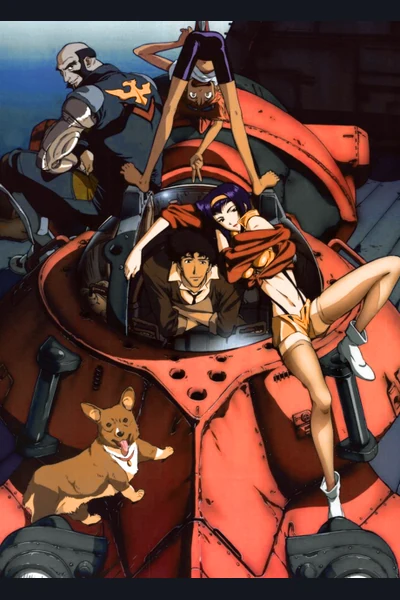
In 2071, bounty hunters Spike Spiegel and Jet Black cross the Solar System aboard the Bebop, pursuing criminals whose rewards rarely survive the damage caused during collection. They are eventually joined by gambler Faye Valentine, hacker Edward and Ein, a corgi whose intelligence exceeds the crew average while remaining tactfully unmentioned.
Directed by Shinichiro Watanabe at Sunrise, Cowboy Bebop aired in Japan across 1998–99 after an initial broadcast complicated by content restrictions. The complete 26-session series became a landmark international anime, helped by an English dub unusually capable of being recommended without a diplomatic preamble.
Overview
The Solar System is a used future of orbital gates, terraformed worlds, analogue screens, organised crime and takeaway noodles. Technology has advanced while human beings remain broke, lonely and capable of making the same poor decisions across greater distances.
Episodes shift among western, noir, comedy, horror, martial arts and melancholy drama. Most are self-contained jobs; a smaller thread follows Spike's former life in the Red Dragon syndicate and his connection to Julia and Vicious. The episodic cases are not filler. They establish the life from which the characters might escape if they could stop treating the past as a private room with the key still inside.
Why it matters
Music is structural. Yoko Kanno and the Seatbelts move through bebop jazz, blues, funk, rock and styles that sensible soundtrack departments would have separated into labelled cupboards. The opening “Tank!” announces motion; quieter pieces reveal the ache beneath the cool.
Watanabe's direction trusts silence, framing and aftermath. Spike's fluid violence is impressive, but the series is more interested in what he does when nobody is watching. Jet tends bonsai, Faye conceals panic beneath debt and provocation, Ed treats the universe as playground. They become a family while preserving the ability to leave without discussing it.
Its influence in Western fandom is difficult to overstate. Adult Swim exposure, strong localisation and genre familiarity made it a gateway for viewers suspicious of anime stereotypes. That success sometimes traps it beneath the label “anime for people who don't like anime”, an ungenerous fate for a work so thoroughly made from Japanese animation's possibilities.
What to expect
Expect gun violence, organised crime, drug references, death and adult melancholy. Comedy ranges from bounty farce to mushroom-related collapse. Romance exists chiefly as memory and damage. The series is mature without confusing maturity with permanent darkness.
Animation varies with episodic style but remains expressive and cinematic. Its future has aged remarkably well because the production designed places rather than gadgets and allowed them to become dirty.
Adaptations and versions
The television anime is the source and complete work. Cowboy Bebop: The Movie—also known as Knockin' on Heaven's Door—fits late in the television chronology and works best after meeting the full crew, roughly between sessions 22 and 23.
Manga adaptations exist but are secondary. Netflix's live-action series reinterprets characters and events with a broader tone; it was cancelled after one season and should be approached as an alternate experiment, not a replacement or required continuation.
Where to start
Watch session one, “Asteroid Blues”, then continue in broadcast order. Do not use a plot-only list. The apparently standalone episodes are where the series teaches you who these people are. Add the film near the end or after completing the series.
Verdict The SFcrowsnest take
Cowboy Bebop is cool, but cool is its surface tension, not its subject. Beneath the jazz, gunplay and immaculate coats is a story about people carrying histories they cannot spend and a family they cannot quite admit has formed.
Concise, adult and formally confident, it remains one of anime's finest introductions and one of its finest conclusions. See you, space cowboy. The line became famous because the programme understood that every departure had already begun.