
Mobile Suit Gundam Wing
Five pretty-boy pilots and their elegant Gundams ignite a war between Earth and its colonies; the series that, via Toonami, finally made Gundam a genuine Western phenomenon.
Overview
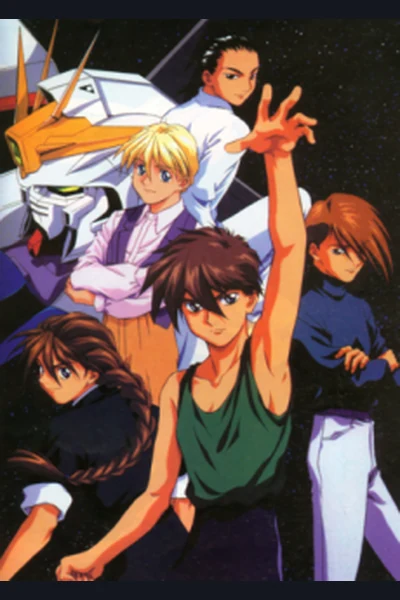
Mobile Suit Gundam Wing is the Gundam series that turned elegant teenage pilots and politically charged mecha warfare into a major Western gateway. Set in its own continuity rather than the original Universal Century, it follows five young Gundam pilots sent from space colonies to Earth, where revolution, militarism and aristocratic idealism are already busy making everything worse.
For many viewers outside Japan, especially those who encountered it through televised anime blocks, Gundam Wing was not a spin-off. It was Gundam. The designs were memorable, the pilots were intensely marketable and the politics were just dense enough to make adolescence feel as though it had acquired a foreign policy department.
Why it matters
Gundam Wing matters because of its export impact. It helped make the Gundam brand genuinely visible to a large Western audience, proving that a military SF franchise with continuity, factions and moral ambiguity could survive the jump into mainstream youth television.
It also represents a specific 1990s reinterpretation of Gundam concerns. War, pacifism, colonial grievance and charismatic militarism are all present, but filtered through a more theatrical, character-forward style. The five pilots are less ordinary soldiers than icons: damaged, beautiful, secretive and apparently allergic to straightforward conversation.
What to expect
Expect stylish mobile suits, political speeches, shifting alliances and protagonists who treat emotional processing as a security breach. The series has tremendous visual and musical identity, even when its plotting becomes labyrinthine. It is full of coups, masked figures, factions within factions and teenagers making decisions with consequences that would alarm any responsible adult, had one been available.
Modern viewers may find the pacing uneven and some of the politics melodramatic. That said, its intensity is part of its appeal. Gundam Wing does not merely ask whether war is wrong. It asks the question repeatedly from balconies, cockpits and secret bases, while someone in the background changes uniforms.
Adaptations and versions
Gundam Wing is an original Sunrise television anime, later extended through OVA and film-format sequel material, plus manga and novel side works. It stands apart from the main Universal Century timeline, which makes it comparatively accessible for newcomers.
This page preserves its merged source rows from both the main anime-manga spreadsheet and the Gundam-specific tab. Final publication should fact-check edition titles, sequel naming and current availability.
Where to start
Start with the television series. It is the foundation and still the best way to understand why the property hit so hard internationally. After that, move to the sequel material if the characters and politics have taken root.
It is not necessary to watch earlier Gundam first, though knowing the franchise's larger concerns will enrich the experience. Gundam Wing is a side door into the mansion. A dramatic side door, certainly, with someone brooding beside it.
Verdict The SFcrowsnest take
Mobile Suit Gundam Wing is stylish, overwrought and historically crucial for Gundam's Western profile. It may not be the neatest political mecha drama Sunrise ever made, but it has presence by the hangar-load. Also, few series have made pacifism look quite so fond of explosions.