Bungo Stray Dogs
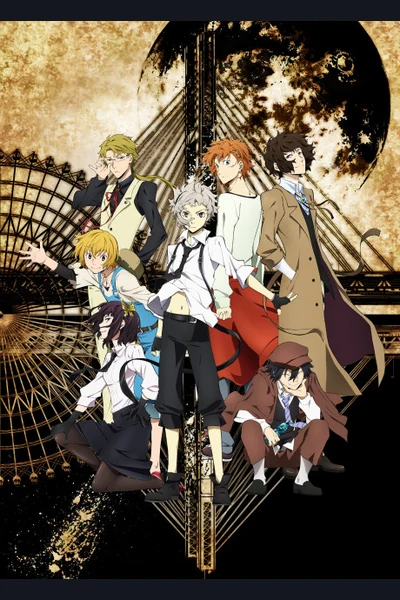
A detective agency of super-powered misfits, each named for a famous author, wages war on the mafia and worse; stylish supernatural crime with a literary in-joke at its heart.
Overview
Bungo Stray Dogs asks a question literature departments have somehow failed to settle: what if famous authors were supernatural crimefighters, mafia operatives and walking special effects? Kafka Asagiri and Sango Harukawa's series turns names from Japanese and world literature into stylised action characters, then sets them loose in a Yokohama of detective agencies, gang wars and occult conspiracies.
The premise could have been a single joke wearing a nice coat. Instead, it became a durable action franchise, helped enormously by Studio Bones' anime adaptation, which gives the battles snap and the character entrances the full theatre-curtain treatment.
Why it matters
The literary-name conceit is the hook, but the series' staying power comes from its found-family dynamics and its taste for operatic criminal melodrama. The Armed Detective Agency and the Port Mafia are not subtle institutions. They are the sort of workplaces where human resources would last twelve minutes before being hurled through a wall.
Bungo Stray Dogs also demonstrates how anime and manga can remix cultural capital into pop spectacle. Viewers do not need to have read Osamu Dazai, Ryunosuke Akutagawa or Fyodor Dostoevsky to follow the plot, though knowing the references adds an extra layer of private amusement. It is literary cosplay with actual knives behind the fan.
What to expect
Expect stylish supernatural action, tragic backstories and a cast that expands steadily until the opening credits begin to resemble a conference programme. The series moves between comedy, noir-ish crime business and high-stakes battles. It can be very funny, then suddenly earnest enough to require a dim lamp and a window streaked with rain.
The treatment of historical literary figures is playful rather than scholarly, so purists should unclench early. The show is not offering a seminar. It is offering a man named after an author turning trauma into a combat system.
There is violence, some dark psychological material and recurring themes of abuse, exploitation and suicidal ideation. The series often handles these through heightened melodrama, but they are still part of the fabric.
Adaptations and versions
The manga, written by Kafka Asagiri with art by Sango Harukawa, is the source. The anime by Bones is the best-known adaptation and a strong visual showcase for the material, with multiple seasons and related film material extending the property.
There are also spin-offs and side stories, which is unsurprising for a series whose cast keeps breeding subplots in the walls. Newcomers do not need them immediately.
Where to start
Start with either the manga or the anime's first season. The anime is more immediately accessible if you want the pace and polish of Bones' action direction. The manga is the better route if you prefer to take the character introductions at the printed page's speed.
If the early comedy feels broad, give the story a little room. Bungo Stray Dogs grows more confident when the rival factions and past histories begin to interlock.
Verdict The SFcrowsnest take
Bungo Stray Dogs is literary reference as supernatural gangland theatre, which is a more entertaining sentence than one has any right to type. It is sometimes overwrought, sometimes knowingly ridiculous and often extremely handsome. Think book club, but the book club has a sniper on the roof.