
Blue Lock
Football reimagined as a Battle Royale prison engineered to breed one monstrously selfish striker; deeply unhinged, weirdly motivational.
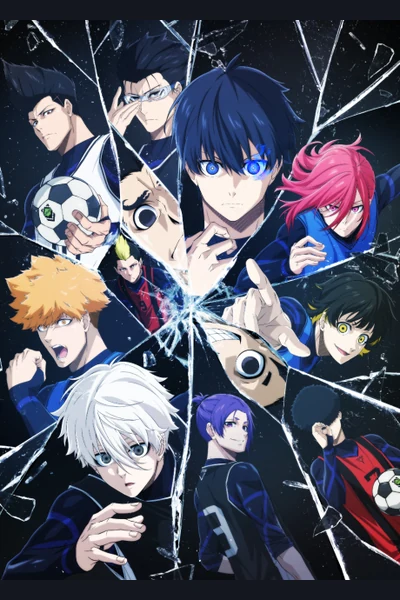
Japan wants to win the football World Cup. The proposed solution is not better youth coaching, broader participation or a patient discussion of sporting infrastructure. It is to lock 300 teenage strikers inside a high-tech compound and encourage them to become the most selfish forward alive. Football has finally been reorganised by somebody who thought the problem with a team sport was the team.
Muneyuki Kaneshiro writes Blue Lock, with art by Yusuke Nomura. The manga began in Kodansha's Weekly Shonen Magazine in 2018, and Eight Bit's anime adaptation followed in 2022. The series takes football, strips away most normal coaching language and presents player development as a battle manga in which elimination means the destruction of one's national-team future rather than literal death. This is still melodramatic, but considerably easier on the cleaning staff.
Overview
Yoichi Isagi enters Blue Lock after passing when he might have taken the decisive shot in a school match. The programme's architect, Jinpachi Ego, tells the candidates that Japan lacks an egotistical striker capable of devouring opportunities. His vocabulary includes chemical reactions, weapons, flow, devouring and occasionally football, though never for so long that anybody might relax.
Players compete through shifting teams and selection stages designed to expose individual strengths. Isagi is not the fastest or most technically dazzling. His weapon is spatial awareness: he reads positions, predicts developing chances and gradually learns to impose himself upon them. The series makes thought visible through diagrams, fragments, eyes and internal monologue intense enough to qualify as additional cardio.
Around him is an assembly of strikers with distinct obsessions: Bachira's playful dribbling, Chigiri's speed, Kunigami's heroism, Nagi's effortless control and Barou's conviction that monarchy is a viable tactical system. Rivals become teammates and teammates become obstacles, allowing every match to rearrange the social furniture.
Why it matters
Blue Lock succeeds by understanding that sport already contains the structure of battle manga. Training reveals abilities, matches produce transformations and rivals force improvement. The series merely turns the psychological volume until a penalty area feels like a supernatural domain.
Its doctrine of ego is knowingly provocative. Real football depends upon cooperation, off-ball labour and systems larger than one striker. Blue Lock does not entirely deny this; it repackages cooperation as the collision of individual ambitions. Players form combinations because each wants to score. Teamwork survives, but has been required to wear sunglasses and call itself a chemical reaction.
This produces a compelling argument about agency. Isagi begins by making the safe pass and learns to accept responsibility for the shot. Ego here means the willingness to choose, fail and reconstruct oneself—not merely refusing to give anybody else the ball, although several characters conduct extensive field research into that option.
What to expect
Expect matches heavy with internal analysis, stylised visual metaphors and declarations that would alarm an ordinary PE teacher. Knowledge of football helps but is not essential. Tactical ideas are simplified and dramatised for character effect. This is not a coaching manual unless one's coach regularly locks the exits.
There is little conventional romance. Rivalry supplies the intimacy, complete with jealousy, fascination and repeated promises to devour one another. Violence is sporting rather than lethal, though collisions occur and the psychological pressure is extreme. Comedy comes from oversized personalities and the contrast between apocalyptic self-talk and teenage communal living.
Nomura's manga art is a major attraction, making sprints and split-second decisions feel viciously dynamic. The anime captures the performances and key moments, though the consistency and amount of visible movement have prompted debate among viewers. Football is peculiarly unforgiving of static presentation because everybody knows the players should be running.
Adaptations and versions
The manga is the strongest version for visual energy and the furthest progression through the competition. The television anime follows the main selections in order. Blue Lock: Episode Nagi retells and extends events from Seishiro Nagi's perspective; it works best after the relevant television material rather than as a first introduction.
Games and spin-offs expand the commercial fixture list but are not necessary. Read the manga from volume one or watch the television series in order, adding Episode Nagi once Nagi's role is established.
Where to start
Try the first two anime episodes or manga volume one. The opening establishes both Isagi's regret and Ego's deranged thesis. If the sight of teenagers discussing personal evolution as though preparing hostile corporate takeovers makes you smile, the doors have already locked behind you.
Verdict The SFcrowsnest take
Blue Lock is football viewed through the feverish eye of competitive individualism. It is absurd, visually aggressive and far more thoughtful about decision-making than its prison-camp sales pitch suggests. The real subject is not selfishness but authorship: who takes responsibility for the decisive moment?
Football purists may object that the sport has been mugged by a battle manga. They are correct, but the battle manga has excellent pace and appears to understand the offside rule. Recommended for sports fans who enjoy psychological rivalry, tactical diagrams and strikers treating self-knowledge as a contact sport.