
Haikyu!!
A short kid simply wants to play volleyball; somehow Production I.G turn 'receive, set, spike' into genuinely heart-stopping drama. No notes.
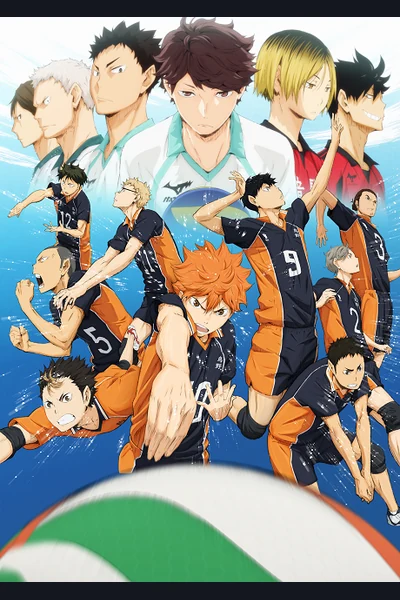
Shoyo Hinata sees a short volleyball player called the Little Giant competing on television and decides that height need not determine destiny. This is inspiring but leaves the practical difficulty of being short in a sport where the net has made its position extremely clear.
Haruichi Furudate's manga ran in Shueisha's Weekly Shonen Jump from 2012 to 2020 and filled 45 volumes. Production I.G's anime began in 2014, followed by multiple seasons, OVAs and theatrical continuations. It turns receiving, setting and spiking into drama with the urgency of bomb disposal, despite everybody agreeing that the ball may touch the floor occasionally and civilisation will continue.
Overview
Hinata enters Karasuno High and discovers that Tobio Kageyama, the brilliant and overbearing setter who defeated his middle-school team, is now a teammate. Hinata has speed and jumping power but little formal experience. Kageyama possesses technical genius and the interpersonal warmth of an automated gate.
Their quick attack depends upon absolute coordination: Kageyama sets precisely to Hinata's blind leap. It begins as a spectacular shortcut and develops into a partnership requiring each boy to see the other as more than equipment. Around them, Karasuno's full squad supplies leadership, defence, anxiety and the essential ability to stop two first-years from making the gym uninhabitable.
Why it matters
Furudate understands team sport as a network of specialised labour. A point may belong to the spiker in the photograph, but it was built by a receive, a decoy, a set and players creating space without touching the ball. Haikyu!! makes invisible contribution legible.
Opponents receive the same care. Rival schools have systems, histories and players whose ambitions remain valid when Karasuno enters the building. Losing does not prove a team morally inferior. It proves that sport produces one result from two sets of serious effort, which is why the handshake afterwards can hurt.
The series is also generous about improvement. Talent matters, but so do repetition, observation, nutrition, rest and learning what one does not know. Hinata's progress is satisfying because enthusiasm cannot substitute for skill; it can only keep him practising long enough to acquire it.
What to expect
Expect volleyball, comedy, rivalry and almost no conventional villainy. Physical injuries and crushing defeats occur, but violence is limited to sporting collision and the psychological damage of a blocked spike. Romance is virtually absent. The central intimacies are between teammates and rivals learning how one another moves.
Production I.G gives matches extraordinary spatial clarity. The viewer can understand where players stand, why a tactic works and how speed changes momentum. Music and editing intensify decisive points without pretending every rally requires a thunderstorm.
Later animation changes visual style and production methods, which some viewers prefer less, but performances and match construction remain strong. The manga's line becomes increasingly fluid, capturing motion without losing tactical information.
Adaptations and versions
The manga is complete and includes the full long-term shape of its characters. The anime covers major school competition arcs through television seasons, OVAs and films. Compilation films recap earlier material; they are not substitutes for the series unless speed matters more than character development.
The theatrical concluding project compresses later manga material, so readers wanting every match and transition should continue with the books. Check current film availability and placement before publication.
Where to start
Begin with anime episode one or manga volume one. The anime is an especially effective gateway because the sound of shoes, hands and ball gives the sport immediate force. Continue in release order, checking OVA placement between seasons. No knowledge of volleyball is necessary; the series teaches rules through desire rather than lecture.
Verdict The SFcrowsnest take
Haikyu!! proves that stakes do not require death, magic or a government conspiracy. A serve matters because the characters have trained for it, the team depends upon it and the opponent has trained just as hard to stop it.
Funny, humane and technically lucid, it is among the finest sports manga and anime. Production I.G turns matches into suspense; Furudate turns rivals into people one is sorry to see lose. Recommended without reservation, including to viewers who believe they dislike sport. The net remains high. The storytelling clears it.