The Restaurant at the End of the Universe
Generally rated the sharpest of the sequels, with the B Ark as perhaps the most pointed satirical conceit in comic SF.

The essential authors of science fiction, fantasy & horror — and where to start reading them.
Book Entry · Science Fiction
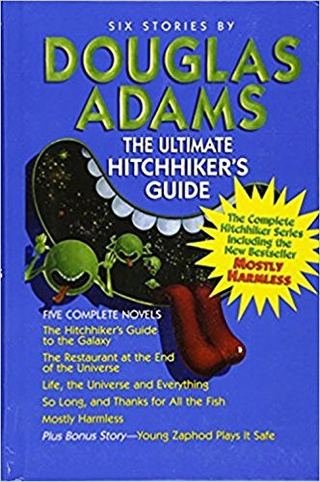
by Douglas Adams · 1979 · The Hitchhiker's Guide to the Galaxy, book 1
Arthur Dent's house is demolished for a bypass on the same Thursday the Earth is demolished for a hyperspace bypass — the paperwork was on display in Alpha Centauri for fifty years, no excuse for apathy. Rescued by his friend Ford Prefect (a researcher for the titular electronic guidebook, whose entry for Earth reads 'Mostly harmless'), Arthur falls in with two-headed ex-president Zaphod Beeblebrox, Trillian, and Marvin, a robot with a brain the size of a planet and clinical depression to match, in pursuit of the legendary planet Magrathea and the Question to which the Answer is 42. Adapted from the 1978 radio series; quotable to the point of public hazard.
The funniest book the genre has produced and one of the most beloved British novels of any kind — radio, TV, film, towel and the name of at least one asteroid attest to a cultural footprint few authors match.
Adams's increasingly inaccurately named trilogy in five parts: Arthur Dent, Ford Prefect, one towel, and a universe that is not merely stranger than imagined but actively taking the mickey.
In the Guide from The Hitchhiker's Guide to the Galaxy:
Prefer Amazon? Buying through these links may earn SFcrowsnest a small commission, at no extra cost to you.
Buy on Amazon UK → Buy on Amazon US →As an Amazon Associate, SFcrowsnest earns from qualifying purchases.
Generally rated the sharpest of the sequels, with the B Ark as perhaps the most pointed satirical conceit in comic SF.
A masterpiece of comic SF and a quiet syllabus of AI ethics before the field existed; its simulated-worlds fable ('The Seventh Sally') is standard citation in philosophy-of-mind courses.
Hugo and Nebula winner, and one of the most reprinted SF stories ever written — the genre's definitive fable of civil disobedience.