The Amber Spyglass
Whitbread Book of the Year 2001 — the first children's book ever to take the overall prize — and the most theologically audacious bestseller in the YA canon; the trilogy's capstone and lightning rod alike.

The essential authors of science fiction, fantasy & horror — and where to start reading them.
Book Entry · Science Fiction
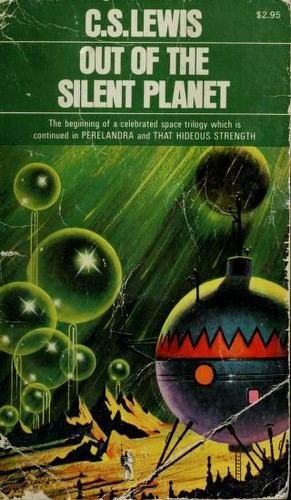
by C. S. Lewis · 1938 · The Cosmic Trilogy, book 1
Philologist Elwin Ransom, on a walking tour, is chloroformed by a megalomaniac physicist and a venal businessman and shipped to Malacandra — Mars — as a presumed human sacrifice. Escaping, he discovers a world without the Fall: three intelligent species sharing a dying planet without war, under the governance of luminous eldila and the planetary intelligence Oyarsa, who reveals why Earth is called Thulcandra, the silent planet, and what bent spirit governs it. Lewis wrote it to answer the interplanetary imperialism of Wells and Stapledon — Weston's climactic speech for colonising the universe is translated, sentence by deflating sentence, into plain Malacandrian and collapses on contact.
The great theological riposte within early SF — proof the genre could argue with itself at planetary scale — and the seed of the Ransom trilogy, whose finale That Hideous Strength fed directly into modern dystopian fantasy.
Out of the Silent Planet, Perelandra and That Hideous Strength: Lewis's interplanetary romances, in which the silent planet is Earth and the space between worlds is anything but empty.
In the Guide from The Cosmic Trilogy:
Prefer Amazon? Buying through these links may earn SFcrowsnest a small commission, at no extra cost to you.
Buy on Amazon UK → Buy on Amazon US →As an Amazon Associate, SFcrowsnest earns from qualifying purchases.
Whitbread Book of the Year 2001 — the first children's book ever to take the overall prize — and the most theologically audacious bestseller in the YA canon; the trilogy's capstone and lightning rod alike.
Winner of the Hugo, Nebula, Locus and Bram Stoker awards in one sweep — the codifying text of the gods-among-us genre — and a Starz television series besides.
The keystone hollow-earth adventure, launching a seven-book series (Tarzan eventually visits).