Who was Terry Pratchett?
A Beaconsfield journalist and nuclear-industry press officer who began the Discworld as a parody of fantasy clichés and ended it, forty-one volumes later, as the sharpest sustained satire of the real world in modern English letters — religion, policing, war, banking, the press and death itself, the last personified in capitals and fond of cats. Britain's bestselling author of the 1990s (knighted 2009, having forged his own sword from meteorite iron, because of course), he wrote with a fury his geniality disguised: the famous quote about starting with anger applies. Diagnosed with posterior cortical atrophy in 2007, he campaigned ferociously for assisted dying and kept writing until the end. The Discworld carries more practical moral philosophy than most ethics departments.
Why they matter
The most beloved British writer of his generation and comic fantasy's permanent summit: Discworld proved a fantasy series could be a complete satirical instrument, and characters like Vimes, Granny Weatherwax and DEATH have entered the culture's shared furniture.
Essential books — and where to start
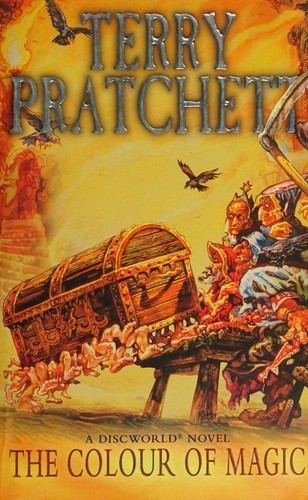
1983 · Discworld, book 1 · Fantasy · Comic Fantasy
Twoflower, the Discworld's first tourist — four-eyed, relentlessly optimistic, owner of sapient pearwood Luggage that follows him on hundreds of little legs and eats people who threaten it — arrives in Ankh-Morpork with a camera and inconvenient quantities of gold, and is assigned for safekeeping to Rincewind: failed wizard, accomplished coward, fluent in scream. Their flight across the Disc parodies Leiber, McCaffrey and the entire fantasy shelf, ends on a literal cliffhanger over the Rim, and introduces a flat world on four elephants on the turtle Great A'Tuin, sex unknown. The satire is still warming up; the furniture is already immortal.
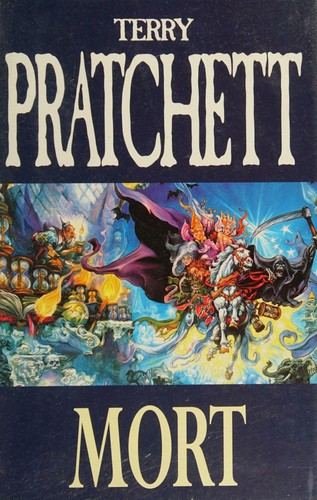
1987 · Discworld, book 4 · Fantasy · Comic Fantasy
Death — seven feet of bone, BLUE-EYED SOCKETS, SPEAKS LIKE THIS, fond of cats and curious about curry — takes an apprentice: Mort, a gangling boy whose family despaired of him. The duties (THERE IS NO JUSTICE. THERE IS JUST ME.) go smoothly until Mort, sent solo, saves a princess he was meant to collect, splitting reality into a shrinking bubble where she remains alive while the universe insists otherwise. Meanwhile his employer, off duty for the first time in eternity, tries his bony hand at fly fishing, gambling and gainful employment as a short-order cook. The book where Pratchett discovered his series' beating heart was a skeleton's.
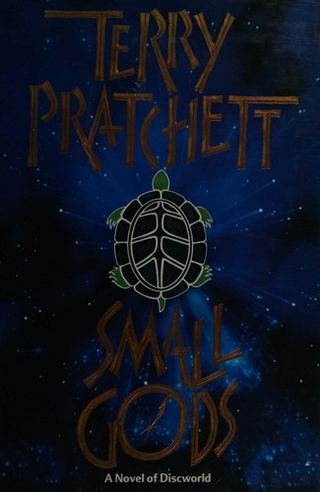
1992 · Discworld, book 13 · Fantasy · Comic Fantasy, Satirical SF
The Great God Om returns to his mighty theocracy of Omnia for his scheduled manifestation and finds himself a one-eyed tortoise — because belief is what gods are made of, and Omnia's millions believe in the Church, the Quisition and the structure, not the god. His sole genuine believer is Brutha, a novice too simple to be promotable, with a perfect memory and no malice, now carrying his deity around in a wicker box while the Church's terrifying Exquisitor Vorbis plots holy war. Pratchett's anatomy of religion — faith versus institution, ethics versus obedience, and the desert where dead gods howl — delivered with jokes that detonate twice.
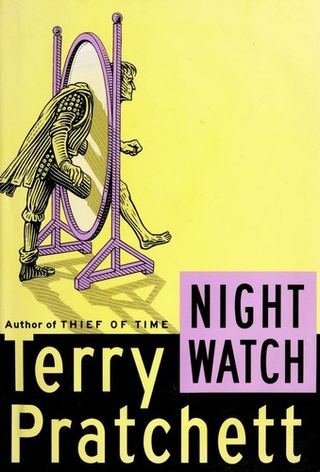
2002 · Discworld, book 29 · Fantasy · Comic Fantasy, Time Travel
Chasing the murderer Carcer across the University rooftops in a magical storm, Commander Sam Vimes is thrown thirty years back — to the Ankh-Morpork of his own brutal youth, days before the Glorious Revolution of Treacle Mine Road, with the mentor who shaped him dead on arrival and the vacancy now his to fill. Teaching his own younger self to be a copper, policing a city sliding toward the barricades, knowing how few of the men beside him survive the lilac-scented morning: Pratchett plays it almost entirely straight, and the result is the series' masterpiece — Les Misérables with better policing theory and one perfect hard-boiled egg.
Series
1934–2011 · British
The bridge between the Inklings and modern fantasy's craft: her deconstructions anticipated and outwitted the genre's clichés decades before 'subversion' became a selling point, and her influence runs through Rowling's generation whether acknowledged or not.
b. 1951 · American
Ender's Game is one of the most widely read SF novels ever published — a recruiting text for the genre itself, taught in schools and military academies alike — and its sequel's compassionate alien-understanding remains a benchmark for first-contact ethics.
1931–2009 · American
The gateway epic fantasist for a generation of 1980s–90s readers: the Belgariad's chatty, character-first formula taught millions that doorstop fantasy could be comfort reading, and its fingerprints are on every found-family quest since.
