
Your Name & the films of Makoto Shinkai
Two teenagers swap bodies across time and space and shattered the box office doing it; Shinkai paints weather, light and yearning like nobody else alive.
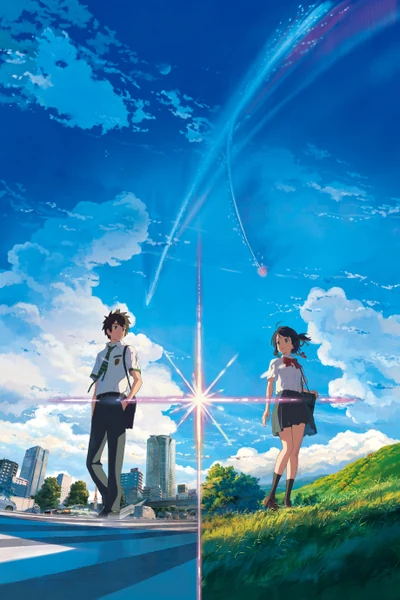
Mitsuha is a schoolgirl in rural Japan who dreams of Tokyo. Taki is a Tokyo schoolboy working in an Italian restaurant. They begin waking in one another's bodies, leaving notes, negotiating rules and discovering that somebody else's life is easier to improve before breakfast than one's own. Then Your Name quietly changes the nature of the problem and demonstrates why apparently simple romances should not be trusted near celestial events.
Makoto Shinkai wrote and directed the 2016 film at CoMix Wave Films. Its global success made him one of the few anime directors widely known outside regular fandom and encouraged endless attempts to nominate a “new Miyazaki”, a job title neither filmmaker had advertised.
Overview
Your Name combines body-swap comedy, romance, memory and disaster. Shinkai's recurring concern is distance: between people, places, moments and messages that arrive too late. Technology connects his characters but rarely solves timing. A phone can carry a feeling across a city; time itself remains less cooperative.
Earlier work develops these themes in different keys. Voices of a Distant Star sends messages across interstellar delay. The Place Promised in Our Early Days joins alternate history to adolescent separation. 5 Centimetres per Second examines the slow erosion of connection. Children Who Chase Lost Voices moves towards mythic adventure, while The Garden of Words encloses loneliness in rain and an age-gap relationship that warrants careful discussion.
Why it matters
Shinkai's images make modern environments romantic without making them unreal. Power lines, trains, convenience stores and reflected skies become emotional architecture. His light is famous, but the precision beneath it matters more: weather tells the viewer how a place feels before dialogue attempts to catch up.
Your Name balanced his earlier melancholy with plot momentum, comedy and broad emotional release. RADWIMPS' music helps the film move through montage and time without turning it into an extended video. Its success opened further international theatrical space for original anime films not attached to established franchises.
What to expect
Expect romance, supernatural mechanisms, disaster imagery and intense yearning. Violence is minimal, though death and grief matter. Body-swap comedy includes adolescent curiosity about bodies. Shinkai's films often idealise connection while remaining painfully alert to missed chances.
Weathering with You (2019) turns climate and magical weather into a rebellious romance. Suzume (2022) sends a girl across Japan closing supernatural doors linked to disaster and mourning, accompanied for part of the journey by a three-legged chair. Shinkai's furniture has better character arcs than some supporting humans.
Adaptations and versions
The films are standalone, though later works contain playful cameos. Novelisations and manga adaptations exist, often written or supervised by Shinkai, but the animated films are the principal versions because image, music and timing carry the experience.
There is no continuity order. Release order reveals Shinkai's development; a selective route is equally legitimate. Check dub casts and editions according to preference rather than assuming subtitles possess automatic moral superiority.
Where to start
Begin with Your Name. Continue to Weathering with You and Suzume for the large-scale recent trio. Then try 5 Centimetres per Second for concentrated melancholy or The Garden of Words for visual intimacy. Keep emergency chocolate nearby if choosing the former.
Verdict The SFcrowsnest take
Your Name is popular because its craft makes longing legible: a hand reaching, a train passing, a name escaping memory. It is clever without treating emotion as a puzzle prize and beautiful without becoming a screensaver.
Shinkai repeats distance, sky and separated lovers because artists are permitted concerns rather than required to reinvent weather. His best films make modern life feel briefly mythic and then charge the characters for the privilege.