
Boys Over Flowers (Hana Yori Dango)
A working-class girl spars with the rich-boy clique ruling her elite school; the best-selling shojo manga ever printed, and the seed of countless Asian TV remakes.
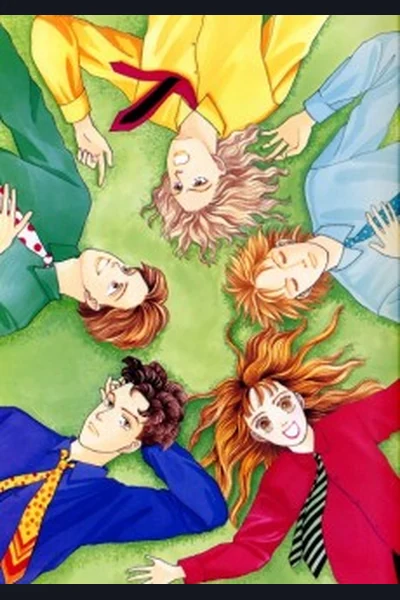
Tsukushi Makino is a working-class student at Eitoku Academy, a school for families who regard wealth as both personality and weather system. The campus is ruled by the F4, four rich boys whose red-card punishment turns classmates against a chosen target. Tsukushi receives one, refuses to submit and declares war on their leader Tsukasa Domyoji.
Yoko Kamio's manga ran in Shueisha's Margaret from 1992 to 2004 and filled 37 volumes, becoming one of the best-selling shojo manga ever published. Toei Animation's television anime aired in 1996–97. Live-action adaptations across Taiwan, Japan, South Korea, China and Thailand turned the premise into a pan-Asian television dynasty.
Overview
Tsukasa is violent, arrogant and gradually fascinated by the girl who hits back. Tsukushi is initially drawn to his quieter friend Rui Hanazawa, producing a triangle complicated by wealth, family pressure and the recurring question of why romantic fiction expects persistence to perform the duties of reform.
Tsukushi's resilience is the engine. She works, worries about money and refuses the elite school's assumption that poverty equals inferiority. The F4's privilege is glamorous on screen and poisonous in practice.
Why it matters
The series established a durable template: ordinary heroine, elite school, rich bully, gentler rival and class barriers capable of funding several seasons. Its many remakes localise wealth and family expectation while preserving the emotional geometry.
Tsukushi remains compelling because she is angry, funny and socially alert. The romance is harder. Tsukasa's bullying and violence are not minor rough edges, and later devotion does not retroactively make early abuse flirtation.
What to expect
Expect school bullying, assault, attempted sexual violence, class humiliation and operatic romance. Comedy and friendship soften the run but do not remove its coercive elements. Modern viewers may enjoy the drama while rejecting the relationship standard offered with it.
Adaptations and versions
The anime adapts a portion of the manga and has a film continuation set in a different entertainment milieu. Major live-action versions include Taiwan's Meteor Garden, Japan's Hana Yori Dango and South Korea's Boys Over Flowers, each with distinct tone and changes.
No version is definitive for every audience. The manga is the complete source; dramas often provide the most culturally familiar route.
Where to start
Read manga volume one for Tsukushi's original voice or choose the live-action adaptation from the culture and era that interests you. Check episode counts and prepare for melodrama to enter without knocking.
Verdict The SFcrowsnest take
Boys Over Flowers is enormously influential because Tsukushi's resistance is exhilarating and the fantasy of crossing class boundaries remains potent. It is also a romance built around behaviour that should not be polished into charm.
Admire the heroine, interrogate the suitor and keep the red card as evidence.