
UFO Robot Grendizer
A saucer-riding alien prince defends Earth in a horned colossus; barely a footnote in Britain, but in France and the Arab world - as Goldorak - it is a god-tier cultural landmark.
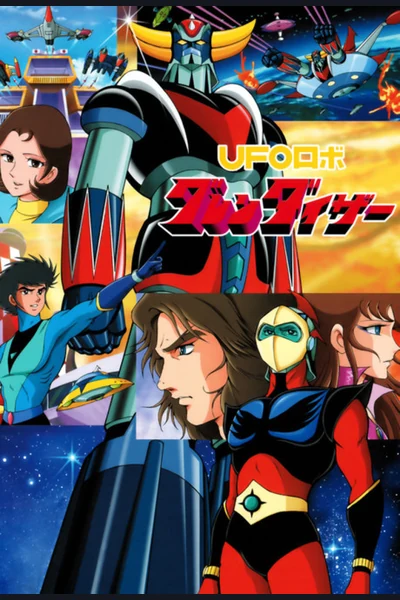
Overview
UFO Robot Grendizer is one of those anime titles whose importance depends very much on which airport you land at. In Britain, it may register as a footnote in the Go Nagai robot family. In France, parts of Europe and much of the Arab-speaking world, where it travelled under names such as Goldorak or Grendizer, it became something closer to a childhood religion with missiles.
The premise is classic 1970s super-robot melodrama. Duke Fleed, an alien prince in hiding on Earth, pilots the mighty Grendizer against the invading forces that destroyed his home. The robot itself launches from a saucer, has a suitably heroic silhouette and carries the general air of something designed by people who knew toy shelves were also battlefields.
Why it matters
Grendizer matters because anime history is not only made in Japan or America. Its export life is extraordinary. For many viewers outside the Anglophone mainstream, this was not an obscure sibling to Mazinger Z; it was the giant robot. Its songs, names and visual rituals became woven into popular memory.
It also shows the 1970s super-robot formula expanding into space opera. The hero is not merely defending a city from weekly monsters. He is an exile, a survivor and a royal fugitive carrying the trauma of planetary conquest. The result is still full of stock footage and shouted attacks, naturally. One must not ask a 1975 super robot to process grief without firing something from its chest.
What to expect
Expect alien invasion, noble suffering, transformation sequences and villains who appear to have dressed for interstellar pantomime. The series has the episodic combat rhythms of its era, but with a stronger emotional through-line than some earlier robot shows.
Modern viewers should adjust for age. The pacing, animation economy and dialogue belong to mid-1970s television. That is not a defect so much as the texture of the object. Grendizer is not trying to be sleek prestige SF. It is heroic space opera for the living room, with tragedy in one hand and a spinning blade in the other.
Adaptations and versions
The property began as an anime from Toei Animation, associated with Go Nagai's larger super-robot world, with manga versions and international edits following. Its naming and release history vary heavily by territory, which makes final publication fact-checking especially useful here.
The Japanese original is the clean reference point. The export versions are historically important because, in some countries, they are the reason the title matters at all.
Where to start
Start with the original anime if you want to understand the 1970s super-robot lineage. Watch it with an eye for its period conventions: repeated launch routines, clear moral stakes and the sheer ceremonial pleasure of a robot doing exactly what the opening credits promised.
If you grew up with one of the dubbed versions, returning to it may be less an act of criticism than archaeology of the nervous system. Some theme tunes never really leave.
Verdict The SFcrowsnest take
UFO Robot Grendizer is a fascinating reminder that cult status is geographical. To one viewer it is a vintage Go Nagai robot show; to another, it is the machine that first proved animation could make the universe feel enormous. Either way, the saucer still has presence.