
The Melancholy of Haruhi Suzumiya
A high-schooler who is unknowingly a reality-warping god assembles a club containing an alien, a time-traveller and an esper; the series that detonated 2000s fandom (chronological viewing order optional).
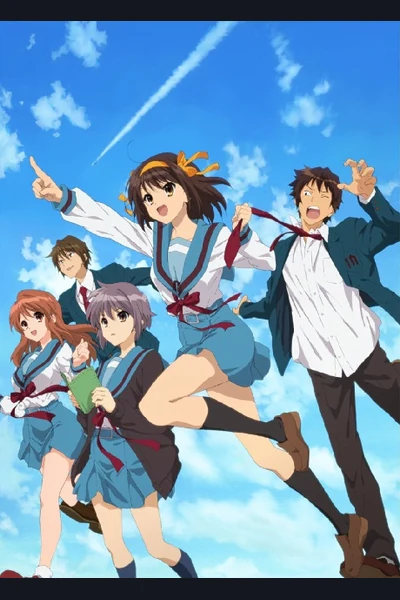
Haruhi Suzumiya has no interest in ordinary humans and would prefer aliens, time travellers, espers or sliders to report directly to her. She forms the SOS Brigade to locate them. Most are already in the club, sent to observe Haruhi because she may possess the unconscious power to rewrite reality. Nobody tells her. The risk assessment has several nervous appendices.
Overview
Nagaru Tanigawa's light novels are narrated by Kyon, a dryly sceptical schoolboy drafted into Haruhi's orbit. Fellow members Yuki Nagato, Mikuru Asahina and Itsuki Koizumi each represent a different supernatural faction while pretending to be normal clubmates. Kyon becomes the only audience for their explanations and the closest thing this arrangement has to a complaints desk.
The series mixes school activities with conceptual science fiction. Haruhi's boredom can generate closed spaces, altered worlds and temporal emergencies, turning adolescent dissatisfaction into a force of nature.
Why it matters
Kyoto Animation's 2006 series became a defining event in international anime fandom. Its non-chronological broadcast order turned structure into participation; the “Hare Hare Yukai” dance escaped the ending credits; a school festival performance acquired the cultural footprint of a touring band.
Beneath the phenomenon is a clever tension between ordinary life and cosmic significance. Kyon claims to want normality while repeatedly choosing wonder, and Haruhi's arrogance hides terror that existence may be dull and she may not matter within it.
What to expect
Expect comedy, metafiction, time loops, unreliable narration and long stretches in which school routine becomes experimental material. The notorious “Endless Eight” tells variations of the same summer episode eight times. It is bold, maddening and much easier to admire after somebody else has watched it weekly.
Haruhi also bullies and sexually harasses Mikuru, behaviour the comedy too often enables. Her charisma does not make this harmless, and newer viewers may find the Brigade's indulgence more alienating than the actual aliens.
Adaptations and versions
The light novels are the source. Kyoto Animation produced television episodes across two broadcast seasons, with chronology deliberately rearranged the first time and regularised later. The feature film The Disappearance of Haruhi Suzumiya continues the animated story and is essential rather than optional franchise garnish.
Manga adaptations and the comic spin-off Haruhi-chan offer other routes, while The Disappearance of Nagato Yuki-chan is an alternate-world spin-off, not the next main chapter.
Where to start
For clarity, use chronological episode order and then watch Disappearance. For historical effect, the original 2006 broadcast order remains a fascinating puzzle, followed by the added 2009 episodes in chronology.
Verdict The SFcrowsnest take
Haruhi is ingenious, irritating and historically unavoidable—the qualities of its heroine scaled to a franchise. Its best work turns teenage restlessness into cosmic unease; its worst mistakes coercion for sparkle. Approach critically, but do approach: the modern fandom landscape still bears the shape of its reality distortion.