
Neon Genesis Evangelion
Teenagers pilot biomechanical horrors while everyone, the show itself included, suffers a magnificent nervous breakdown.
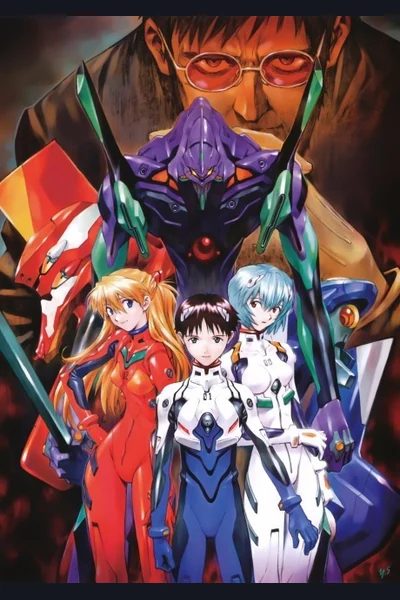
Fourteen-year-old Shinji Ikari is summoned to the fortified city Tokyo-3 by his estranged father, Gendo. A giant being called an Angel is attacking. Gendo commands the organisation NERV and wants Shinji to pilot Evangelion Unit-01, an enormous humanoid weapon whose exact nature is filed beneath “things the adults will explain after several additional catastrophes”.
Hideaki Anno directed the 26-episode television series at Gainax in 1995–96. Yoshiyuki Sadamoto's manga adaptation began earlier as promotion but developed on its own schedule and with its own emphasis. The End of Evangelion supplied a theatrical counterpart to the television conclusion in 1997. Anno later returned through Studio khara for four Rebuild of Evangelion films released between 2007 and 2021.
Overview
Shinji joins fellow pilots Rei Ayanami and Asuka Langley Soryu under operations director Misato Katsuragi. Each is skilled, damaged and placed under intolerable pressure by adults carrying their own damage in larger briefcases. Battles against Angels provide the external structure while NERV, SEELE and Gendo pursue incompatible secret plans.
The series begins as monster-of-the-week mecha drama with sharp comedy and superb direction. It gradually turns inward. Cockpits become wombs, communication becomes injury and the heroic requirement to “get in the robot” starts looking less like courage than institutional coercion.
Why it matters
Evangelion did not invent troubled pilots, religious imagery or psychological mecha, but combined them with exceptional force during a difficult period for television anime and for Anno himself. Limited resources encouraged bold editing, stillness and abstraction. Production difficulty became part of the work's visual language without being the sole explanation for it.
The characters resist tidy diagnosis. Shinji wants affection but fears the exposure required to receive it. Asuka performs superiority against terror of worthlessness. Rei has been denied the ordinary foundations of self. Misato can command a battle and fail at breakfast. Their pain is not a code to solve; it is the medium through which they misunderstand one another.
The Christian and Kabbalistic symbols are atmospheric and structural rather than a reliable theology textbook. Viewers who build a complete doctrinal interpretation may discover the creators selected some imagery because it looked unfamiliar and impressive. This has not prevented several decades of diagrams.
What to expect
Expect mecha combat, body horror, sexual unease, depression, parental abuse, apocalypse and extended psychological confrontation. The series includes comedy and domestic warmth, which makes the later collapse more painful. It is not suitable for younger children despite the teenage pilots and model kits.
The television ending abandons conventional external resolution for interior theatre. The End of Evangelion provides events occurring around that psychological conclusion, not a simple replacement ending. Both are required for the original experience.
Adaptations and versions
Watch the 26 television episodes, then The End of Evangelion. The recap film Death(true)² is optional. Translation and dub differences exist across releases; older credit music may be absent for licensing reasons, so check the edition without treating one subtitle choice as a schism.
The four Rebuild films begin as a compressed retelling and diverge into another work. Watch them afterwards in numbered order. Sadamoto's manga offers a more accessible and differently characterised interpretation, valuable but not the original source.
Where to start
Start with television episode one and accept temporary confusion. Avoid lore explainers until finishing the original series and film; premature explanation replaces discovery with inventory. Then watch the Rebuilds as Anno revisiting, revising and eventually attempting to leave the material.
Verdict The SFcrowsnest take
Neon Genesis Evangelion is a mecha series, a production crisis, a psychological drama and a commercial empire built around characters unable to tell one another what they need. Its mysteries entice, but its emotional accuracy is why the work remains alive.
Not every symbol resolves and not every experiment succeeds. The whole is still essential: formally daring, painfully adolescent and suspicious of every adult who converts a child's need for approval into fuel. Get in the robot if you must. The programme is wise enough to ask who benefits when you do.