
Steins;Gate
A self-styled mad scientist accidentally invents time travel using a microwave and a mobile phone, then bitterly regrets every minute of it; the thinking person's time-loop thriller.
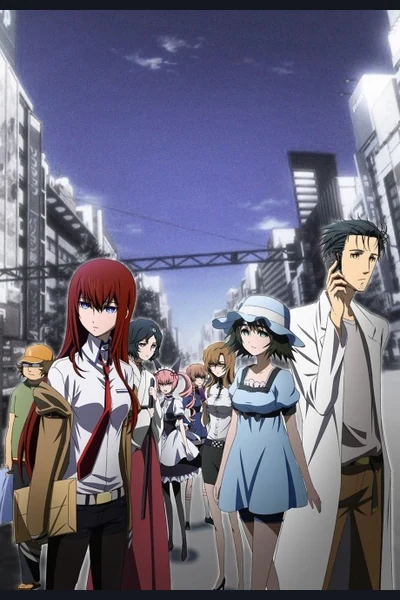
Rintaro Okabe calls himself the mad scientist Hououin Kyouma, operates the Future Gadget Laboratory from a room above an electronics shop and believes a mysterious Organisation monitors his work. Most of that is theatrical nonsense. Then his modified microwave begins sending text messages into the past, and nonsense loses its monopoly.
The Steins;Gate visual novel was released in 2009 by 5pb. and Nitroplus as part of the Science Adventure series. White Fox's 2011 anime became its most widely known adaptation, followed by a film and Steins;Gate 0, an alternate continuation built around failure in the original story.
Overview
Okabe's laboratory includes hacker Daru and childhood friend Mayuri, later joined by neuroscientist Kurisu Makise and other Akihabara acquaintances. Their experiments with D-Mails alter the timeline. Okabe alone retains memories across changes through an ability he names Reading Steiner, because even neurological trauma must submit to branding.
The opening spends time on character comedy, internet culture and apparently inconsequential routines. That patience matters. Time travel becomes frightening only after the audience understands the lives being revised.
Why it matters
The series grounds its machinery in real scientific speculation, internet folklore and Akihabara's 2010 culture without pretending a microwave is peer-reviewed equipment. Its rules are coherent enough to support suspense while leaving room for emotion.
Okabe's performance as Hououin Kyouma begins as embarrassment and becomes protection. The persona helps friends laugh and helps him act when fear would otherwise close the laboratory. Mamoru Miyano's performance in Japanese and J. Michael Tatum's English dub both understand the shift from comic grandiosity to distress.
What to expect
Expect a slow first half followed by an intense psychological thriller involving death, grief, coercion and repeated attempts to alter events. Suicide themes become important in Steins;Gate 0. Romance between Okabe and Kurisu gives the central time-travel problem emotional shape.
Some treatment of female and transgender characters reflects visual-novel conventions and has prompted reasonable criticism. The story is compassionate in intention but not free from awkward framing.
Adaptations and versions
The visual novel offers branching routes, more science detail and alternative outcomes. The 2011 anime compresses these into a strong central narrative. Its OVA is a light epilogue; the film Load Region of Déjà Vu continues emotionally but sits more loosely with the established rules.
Steins;Gate 0 follows an alternate route reached through episode 23β, but should be watched only after completing the original series. It is not season two in a simple chronological sense.
Where to start
Watch all 24 episodes of Steins;Gate. Then, if desired, watch episode 23β followed by Steins;Gate 0. Add the OVA and film afterwards. Do not insert 0 halfway through a first viewing merely because a flowchart has become excited.
Verdict The SFcrowsnest take
Steins;Gate earns its anguish by first letting its characters waste time together. The microwave is ridiculous, the consequences precise and Okabe's journey from performed madness to real strain exceptionally well handled.
The anime is one of science-fiction television's best time-loop thrillers; the visual novel is the fuller laboratory. Begin patiently. The first half is not delaying the plot—it is constructing what the second half cannot bear to lose.