
Samurai Champloo
Two mismatched swordsmen and a waitress wander Edo Japan to a hip-hop beat; Watanabe's stylish follow-up to Cowboy Bebop, all anachronism, attitude and swagger.
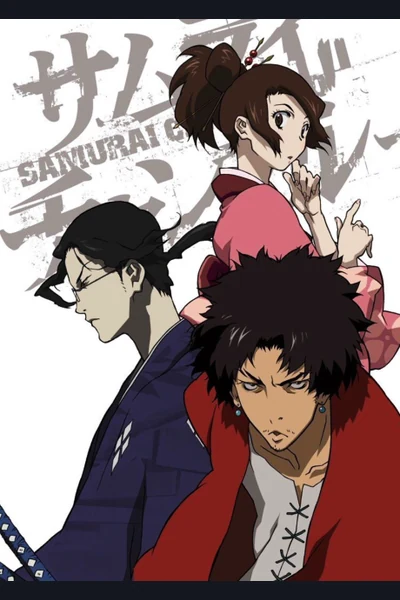
Waitress Fuu saves two swordsmen from execution on condition that they help find a samurai who smells of sunflowers. Mugen is a feral fighter whose style resembles breakdancing conducted with lethal intent. Jin is a disciplined ronin shaped by orthodox sword training. They dislike one another immediately, establishing the stable basis for a 26-episode journey.
Directed by Shinichiro Watanabe and produced by Manglobe, Samurai Champloo aired in 2004–05. It mixes Edo-period travel with hip-hop music, graffiti, baseball and deliberate anachronism. “Champloo” derives from an Okinawan term for mixing, and the series treats historical purity as an ingredient rather than a border guard.
Overview
The trio crosses Japan through criminal schemes, religious persecution, checkpoints and odd jobs. Fuu's search supplies direction while episodic encounters reveal Mugen's Ryukyuan background and Jin's break with his school.
The men are spectacular fighters; Fuu is the reason the journey has purpose. Her apparent lack of combat power does not make her luggage. She negotiates, persists and repeatedly holds together two people whose conflict-resolution strategy damages furniture.
Why it matters
Watanabe uses hip-hop as structural kinship rather than decorative soundtrack. Sampling, remix and individual flow shape editing and combat. Nujabes, Fat Jon, Force of Nature and Tsutchie give the series a musical identity as influential as its swordplay.
The historical episodes play fast with chronology but address real restrictions, minorities and imported culture. Some treatments are broad; the strongest use anachronism to expose how official history decides whose voice counts.
What to expect
Expect sword violence, death, sexual threat, drugs and adult comedy. Tone moves from farce to tragedy without formal notice. The series uses stereotypes at times, but its curiosity about marginal lives is genuine.
The English dub is strong, though the Japanese performances and historical language offer another texture. Music is essential in either version.
Adaptations and versions
The 26-episode anime is the complete primary work. A short manga adaptation exists but is secondary. There are no required films, sequel arcs or continuity annexes—a rare administrative mercy.
Where to start
Watch episode one and continue in order. Individual stories stand alone, but the journey accumulates quietly and the final destination depends upon that time together.
Verdict The SFcrowsnest take
Samurai Champloo has swagger, but not the empty sort sold with sunglasses. Its style grows from three incompatible people moving to different rhythms and somehow remaining on the same road.
Concise, musical and beautifully directed. The sunflower samurai is the destination; the mix is why the trip matters.