
RahXephon
A boy discovers his world is a lie and pilots a singing, godlike mecha against an invading civilisation; a lush, musical, frequently-Evangelion-compared mind-bender.
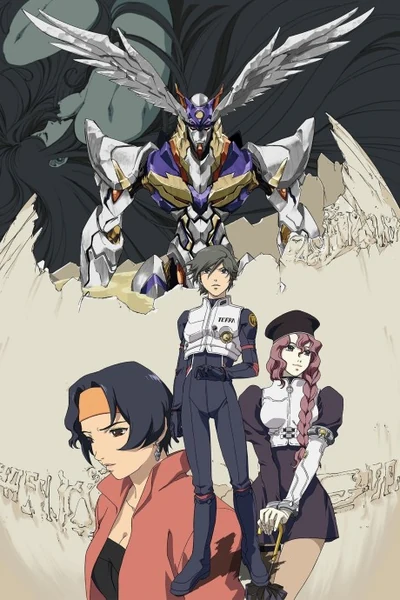
Overview
RahXephon is a lush, cryptic mecha series where music, memory and identity are tuned into weapons. Ayato Kamina believes he lives in Tokyo, but his world is not what it appears. Soon he is drawn into a conflict involving the mysterious Mu, a reality-bending city and the RahXephon itself, a godlike machine whose relationship to song is rather more serious than karaoke night.
Created by Yutaka Izubuchi and animated by Bones, the series arrived in the long shadow of Neon Genesis Evangelion, and comparisons have followed it ever since like an over-attentive relative. They are not useless comparisons, but they can become lazy. RahXephon has its own texture: more romantic, more musical, and often more interested in harmony than breakdown.
Why it matters
RahXephon represents early-2000s psychological mecha at its most polished and self-consciously mysterious. It shares the era's appetite for secret organisations, symbolic machinery and teenagers discovering that adults have been lying with professional enthusiasm.
Its distinctive contribution is the musical metaphor. The story uses tuning, resonance and performance as ways to think about reality and human connection. In lesser hands this could have been decorative nonsense. In RahXephon, the motif gives the show its identity, even when the plot is busy tying knots in the curtains.
What to expect
Expect beautiful design work, moody revelations, romantic longing and a mythology that does not always pause to check whether everyone still has the map. The series rewards patient viewers who enjoy piecing together emotional and cosmological clues.
It can also frustrate. Some viewers find it elegant and moving; others find it too derivative or too opaque. The truth sits somewhere more interesting. RahXephon is not simply Evangelion with better posture. It is part of the same post-Evangelion conversation, asking adjacent questions in a different key.
Content includes war, psychological manipulation, identity confusion and emotional trauma, though the tone is often dreamier than brutal.
Adaptations and versions
The television anime is the core version. There are related manga and film materials, but the TV series is the primary route for understanding the property.
As with many original anime projects, the adaptations and retellings should be treated as companions rather than replacements. The series' pacing and accumulation are central to its effect.
Where to start
Start with the television series. Give it a few episodes to establish the false world, the larger conflict and the emotional triangle at its heart. It is not designed to give up all its secrets immediately.
If you bounce off symbolism-heavy mecha, this may feel like being trapped in a cathedral with a tuning fork. If that image appeals, proceed confidently.
Verdict The SFcrowsnest take
RahXephon is elegant, enigmatic and occasionally over-perfumed, but its musical science-fiction mood still has real power. It may invite unhelpful comparisons, yet it earns its place as one of the more graceful psychological mecha works of its era.