
Eureka Seven
A bored small-town boy runs off with a mysterious girl and a surfboard-riding mecha; a sprawling coming-of-age road trip built around one of the great anime romances.
Overview
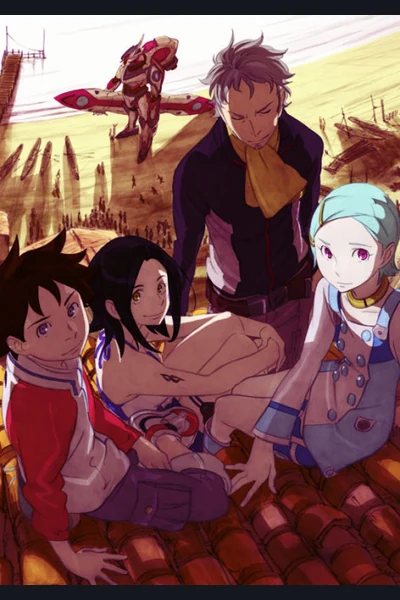
Eureka Seven is a coming-of-age mecha romance in which giant robots surf through the sky, because sometimes science fiction earns its keep by making an absurd image feel emotionally necessary. Renton Thurston is a bored teenager in a nowhere town until the mysterious Eureka, her mecha Nirvash and the countercultural crew Gekkostate crash into his life.
Produced by Bones with Dai Sato among its key creative voices, the series blends road-trip energy, youth rebellion, ecological SF, military conflict and romantic longing. It is sprawling, sometimes indulgent and, at its best, disarmingly sincere.
Why it matters
Eureka Seven became a major 2000s anime touchstone because it gave mecha a warmer, more open emotional register after years of psychological collapse and military misery. It still has war, secrets and trauma, but the core is a boy growing up through love, error and the gradual discovery that adults, rebels and governments are all capable of making an almighty mess.
Its visual identity is also memorable. The lifting boards, aerial movement and music-inflected youth culture give the series a flavour distinct from cockpit-bound robot warfare. It feels like mecha passed through surf culture, rave posters and adolescent yearning, then told to save the planet before curfew.
What to expect
Expect romance, found family, military pursuit, ecological mystery and a long-form character arc that takes its time. Renton can be irritating early on, which is partly the point and partly a test of patience. He is a teenager, not a fully assembled moral instrument.
The series runs long enough to wander, but also long enough to let relationships breathe. Eureka herself is not merely the mysterious girl in the robot; her identity and growth are central to the story's emotional force.
There is violence and some darker material around war, exploitation and prejudice, but the overall tone remains hopeful. Hopeful, not sugary. The distinction matters.
Adaptations and versions
The original television anime is the main work. Later films, sequels and alternate versions exist, and their relationship to the original can be complicated. Newcomers should not start with the spin-offs unless they actively enjoy entering buildings through the chimney.
The TV series remains the essential route, with later material best treated as optional expansion or reinterpretation.
Where to start
Start with the original anime series. Give it time. Eureka Seven is built less like a compact thriller and more like a road journey, with detours, mood shifts and people learning things the hard way.
If the surfboard mecha image makes you smile rather than flinch, you are already halfway there.
Verdict The SFcrowsnest take
Eureka Seven is heartfelt, messy and frequently lovely: a mecha romance with sky under its feet and adolescence in its bloodstream. It has its lulls, but when it catches the right current, it soars.