
Science Ninja Team Gatchaman (Battle of the Planets)
Five bird-costumed teens versus a green-faced supervillain; reworked into Battle of the Planets and G-Force, it bird-styled its way into every British childhood.
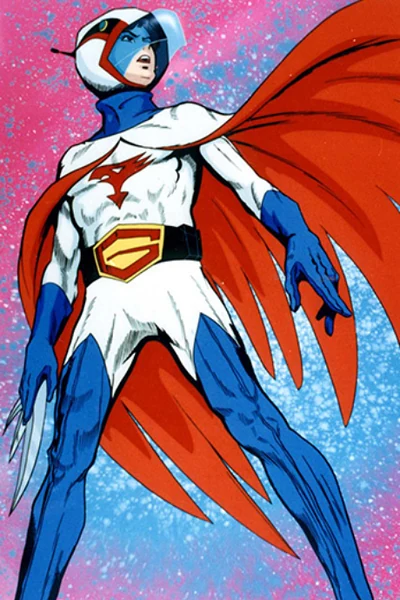
Five young agents in bird-inspired uniforms defend Earth from the terrorist organisation Galactor, led by the masked Berg Katse. They deploy from the aircraft God Phoenix, combine science with acrobatics and demonstrate that capes remain viable tactical equipment if one commits hard enough.
Tatsunoko Production's Science Ninja Team Gatchaman began in 1972 and ran for 105 episodes. Western viewers often met it through Battle of the Planets, a heavily edited 1978 adaptation created in the wake of Star Wars. Later localisations including G-Force: Guardians of Space restored or rearranged different portions, leaving childhood memory divided by robots nobody saw in Japan.
Overview
Ken the Eagle leads Jun the Swan, Joe the Condor, Jinpei the Swallow and Ryu the Owl under scientist Dr Nambu. Their vehicles combine with the God Phoenix, which can transform into a fiery bird for attacks that make subtle infiltration temporarily less relevant.
The original includes death, sacrifice and environmental themes. Galactor's schemes often exploit pollution or technology, giving the superhero action a sharper edge than some overseas broadcasters considered suitable.
Why it matters
Gatchaman helped define the colour-coded team later familiar from sentai and superhero animation. Its aerodynamic designs, transformation sequences and tragic character arcs influenced generations of ensemble action.
Battle of the Planets matters separately as British and American television history. It renamed the team G-Force, shifted much action into space and added robot 7-Zark-7 to explain edited footage and reassure viewers that evacuated cities were not full of casualties. Censorship developed its own supporting cast.
What to expect
The Japanese series is darker and more violent than the edited version, though still family adventure. Expect gunplay, explosions, environmental danger and melodrama. Gender roles reflect the era, with Jun capable but too often assigned the team's single female slot and associated expectations.
Adaptations and versions
Original Gatchaman is the preferred version. Battle of the Planets is a nostalgic alternate edit; G-Force offers another English treatment. Sequels Gatchaman II and Gatchaman Fighter, later OVAs and Gatchaman Crowds reinterpret the name and concept.
Where to start
Choose subtitled Science Ninja Team Gatchaman for the intended story or Battle of the Planets for childhood archaeology. Do not combine episode guides casually; 7-Zark-7 may appear without explanation and begin reporting from whichever continuity is nearest.
Verdict The SFcrowsnest take
Gatchaman is stylish, sincere and more emotionally severe than its Western edit suggested. The bird costumes still look magnificent because Tatsunoko designed them without apology.
The original is the stronger work; Battle of the Planets remains a fascinating act of localisation and a cherished gateway. Both belong in the guide, though only one believes a chatty robot watched the entire battle from a submarine base.