
Ponyo
A goldfish-girl longs to become human; hand-drawn, oceanic and aimed squarely and joyously at small children.
Overview
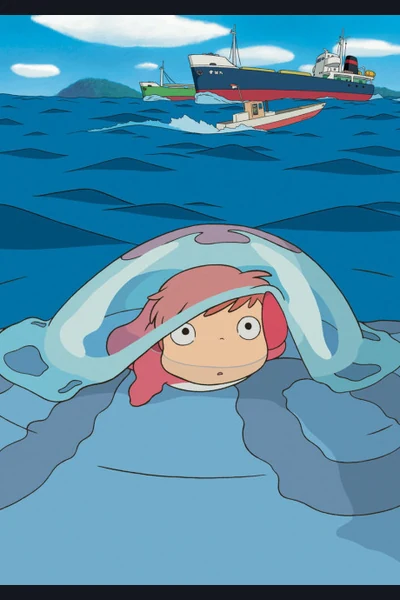
Ponyo is Miyazaki's oceanic sugar rush, loosely brushing against The Little Mermaid and then happily swimming off in its own hand-drawn direction. A fish-girl escapes the sea, meets a small boy named Sosuke and decides that becoming human sounds splendid, especially if ham is involved.
The film is aimed at younger viewers than many late Miyazaki works, but it is not thin. Its simplicity has the force of a wave. The sea boils with magic, parents worry, storms rise, and a child's promise becomes the hinge on which an entire watery imbalance turns.
Why it matters
Ponyo matters because it is a celebration of hand-drawn motion and child-level wonder. After the complexity of films such as Princess Mononoke and Howl's Moving Castle, Miyazaki returns to something elemental: water, food, family, transformation and the overwhelming desire to be where love is.
It is also one of his most tactile films. Everything sloshes, bubbles, eats or glows. The animation has a looseness that makes the sea feel alive rather than merely illustrated.
What to expect
Expect a bright, strange, child-friendly fantasy with moments of genuine mythic scale. Ponyo herself is a force of appetite and affection, less a demure fairy-tale heroine than a small marine emergency with hair.
Adults may notice ecological anxiety, parental strain and the sheer oddness of the cosmic bargain beneath the sweetness. Children may mainly notice Ponyo shouting for ham. Both readings are valid.
Adaptations and versions
Ponyo is an original Studio Ghibli theatrical film directed by Hayao Miyazaki, loosely drawing inspiration from mermaid folklore and Andersen rather than serving as a direct adaptation.
International editions and dubs should be checked before publication.
Where to start
This is one of the easiest Ghibli films for younger children, though very small viewers may find the storm intense.
For adults, it works best if approached as visual music rather than tightly argued fantasy logic. Let the sea in. It has already ignored the front door.
Verdict The SFcrowsnest take
Ponyo is joyous, watery and slightly deranged in the best nursery-myth way. It may be simple, but simplicity is not the same as smallness. Sometimes cinema only needs a fish-girl, a storm and a sandwich filling with destiny.