
Nausicaa of the Valley of the Wind
The toxic-jungle eco-epic that effectively gave birth to Studio Ghibli; a princess, a glider, and one of the great environmental fables put to film.
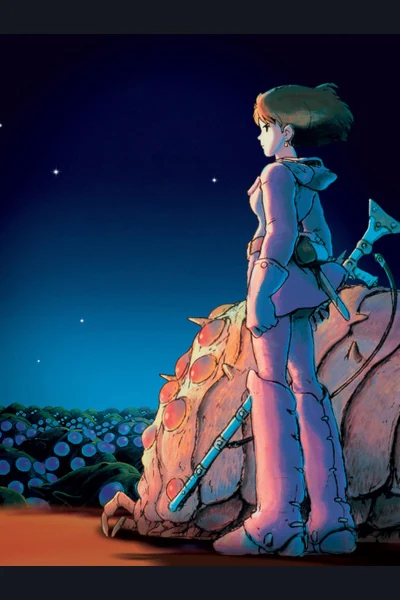
A thousand years after industrial civilisation destroyed itself in the Seven Days of Fire, humanity survives among scattered kingdoms while the Sea of Corruption spreads across the land. Its giant fungi release poisonous spores and its insects object forcefully to redevelopment. Princess Nausicaä of the Valley of the Wind enters this ecosystem with a glider, scientific curiosity and the radical suspicion that nature may not have organised itself solely for human convenience.
Hayao Miyazaki began the manga in Tokuma Shoten's Animage magazine in 1982, continuing it intermittently until 1994. He directed the 1984 animated film at Topcraft before Studio Ghibli formally existed. The film's success helped make Ghibli possible; placing it outside the studio catalogue on a technicality is accurate in the way that excluding the foundations from a house tour is accurate.
Overview
Nausicaä understands wind, machines and the giant Ohmu better than the leaders pushing neighbouring states towards war. When the Valley becomes entangled with Tolmekia and Pejite, ancient weapons and ecological panic threaten another catastrophe.
She is a capable pilot and fighter but not a conventional warrior princess. Her defining ability is attention: she observes what frightened people label monstrous and asks what conditions produced it. The story does not sentimentalise the insects. It simply refuses to assume that human fear is a complete scientific method.
Why it matters
The film contains the Miyazaki concerns that would recur for decades: flight, environmental damage, militarism, young women with practical competence and beautiful machines serving appalling purposes. Joe Hisaishi's score gives the poisoned world grandeur without turning disaster into a tourism campaign.
The manga is considerably larger and politically denser. Nations, religions and engineered ecologies complicate the film's cleaner conflict. Miyazaki's environmental argument also becomes less comforting. Purity itself can be dangerous when people treat a living world as something to reset.
What to expect
Expect aerial action, warfare, death and frightening insects alongside wonder and compassion. The film is suitable for many older children but includes blood, shootings and apocalyptic imagery. It is not cosy Ghibli, although it contains enough fox-squirrel to prevent complete despair.
Adaptations and versions
The film adapts only an early portion of the manga and reshapes events into a complete story. Read all seven manga volumes from the beginning rather than continuing where the film appears to stop.
Avoid the old heavily cut English release Warriors of the Wind, which changed names and removed substantial material. Modern uncut editions are the proper route.
Where to start
Watch the 1984 film, then read the manga. The film is one of animation's great environmental adventures; the books reveal that Miyazaki's full argument is stranger, harsher and less certain.
Verdict The SFcrowsnest take
Nausicaä is not merely the rehearsal for Studio Ghibli. It is a major work in its own right, balancing pulp adventure with ecological thought and refusing the useful lie that one defeated villain can repair a damaged world.
The film belongs in the trophy cabinet. The manga requires a larger cabinet and perhaps an environmental impact assessment.