Legend of the Galactic Heroes
Two brilliant commanders wage a decades-long war between a space empire and a decaying democracy; the definitive thinking-person's space opera, revered by SF readers.
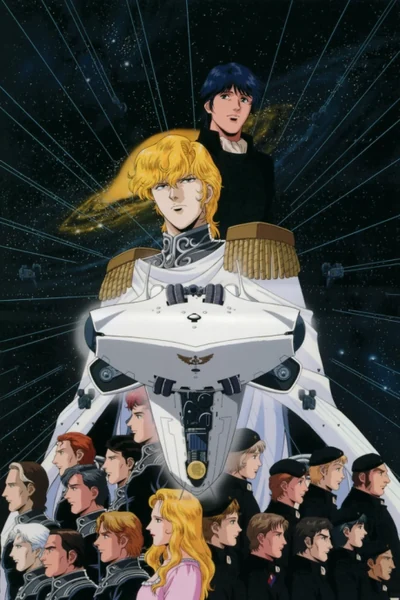
Humanity has colonised the galaxy and reproduced two familiar political arrangements: an autocratic empire with excellent uniforms and a democracy discovering that elections do not automatically prevent corruption. Between them stand two military geniuses, millions of citizens and enough warships to make the insurance claim visible from another spiral arm.
Overview
Yoshiki Tanaka's novel series sets Reinhard von Lohengramm of the Galactic Empire against Yang Wen-li of the Free Planets Alliance. Reinhard intends to overthrow a decaying aristocracy and unite humanity. Yang, a reluctant historian in uniform, defends a democratic state whose leaders often make a persuasive case for letting the enemy have it.
Their campaigns provide the spine, but Legend of the Galactic Heroes is an ensemble political history. Admirals, politicians, civil servants, revolutionaries and civilians all affect the outcome. The narrator sometimes reports events as though scholars are already arguing over the footnotes centuries later.
Why it matters
Few space operas take government this seriously. The series does not ask whether monarchy or democracy is nicer in theory; it asks what each becomes under gifted leaders, fools, institutions, ambition and public exhaustion. A benevolent autocrat may outperform a corrupt democracy today, but what machinery remains tomorrow?
Tanaka also refuses to make intelligence a monopoly of moral virtue. Brilliant plans kill people. Noble principles can shelter cowardice. History advances through logistics and vanity as often as heroism.
What to expect
Expect enormous fleet battles, political debate, classical music, long conversations and a formidable number of named officers. The technology is functional scenery rather than engineering speculation; the real science-fiction instrument is society.
Violence includes wartime death, assassination and civilian atrocity, usually presented with historical sobriety rather than action-film celebration. The series rewards concentration and has no interest in supplying a boss fight every twenty minutes. This is a feast for viewers who regard a constitutional crisis as a set piece.
Adaptations and versions
The ten main novels are the source, accompanied by additional stories. The celebrated original video animation ran for 110 main episodes, with films and Gaiden prequels around it. Its character designs and patient staging are of their period; its ambition has not dated.
Die Neue These, produced decades later, begins the novels again with modern animation and a brisker surface. It is a new adaptation, not a sequel. Manga versions also exist, each making its own visual and narrative choices.
Where to start
The novels offer the cleanest foundation. For animation, Die Neue These is the easier modern doorway, while the original OVA remains the fullest screen account. Do not attempt both simultaneously unless your household has appointed an archivist.
Verdict The SFcrowsnest take
The word “epic” has been worn smooth by marketing departments, but Legend of the Galactic Heroes earns it through scale, thought and consequence. It is less interested in who has the largest laser than in who controls the budget committee funding it. For political space opera, this remains one of the load-bearing works.