Kingdom
A war-orphan claws his way toward becoming a great general amid the bloody unification of ancient China; a sprawling, ferociously popular historical seinen epic.
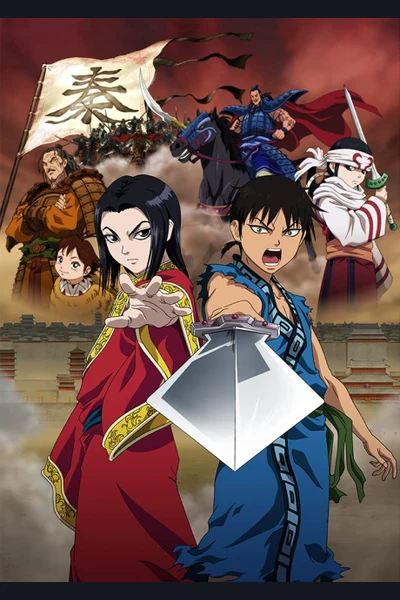
War orphan Xin—Shin in Japanese—dreams of becoming the greatest general under heaven. His path becomes tied to Ying Zheng, young king of Qin and future First Emperor of China, during the final centuries of the Warring States period. The ambition is enormous, the armies larger and the available career ladder mostly composed of spears.
Yasuhisa Hara's manga began in Shueisha's Weekly Young Jump in 2006 and has grown into one of Japan's biggest historical series. A television anime began in 2012, with later seasons improving dramatically upon the first season's notorious computer animation. A successful sequence of Japanese live-action films adapts the early campaigns.
Overview
Shin rises from foot soldier through battle, building the Hi Shin Unit and meeting generals whose tactical philosophies are expressed through formations, charisma and the ability to remove several opponents at once. Ei Sei fights political battles to consolidate Qin and pursue unification.
Historical figures and campaigns provide the skeleton; Hara supplies invented relationships, heroic duels and chronology shaped for serial drama. Knowing that Qin eventually wins does not explain what victory costs or who survives to see the administrative consequences.
Why it matters
Kingdom excels at scale. Hara moves from an individual's fear to thousands of soldiers without losing the geography of battle. Strategy, morale and leadership matter alongside physical strength.
The series treats unification as an answer to endless warfare, but readers should keep historical perspective. Qin's conquest and later rule were violent and authoritarian; heroic framing can simplify populations absorbed beneath another state's destiny. The manga is historical fiction, not an endorsement form supplied by the First Emperor.
What to expect
Expect mass warfare, beheadings, massacres, political assassination and long campaigns. Violence is frequent and sometimes graphic. Comedy and comradeship provide relief; romance is peripheral.
Names vary between Japanese readings and Chinese romanisation, so Shin/Xin and Ei Sei/Ying Zheng may confuse readers crossing editions.
Adaptations and versions
The manga is the fullest version. The anime's first season uses stiff CG that can repel viewers before the story earns them; later seasons move towards stronger traditional presentation and are substantially better.
The live-action films offer handsome, compressed introductions with large-scale production. They cannot carry the manga's full military sprawl but make a persuasive case for the early story.
Where to start
Read the manga if available in a language you use, or endure the first anime season knowing visual reinforcements arrive later. The first live-action film is another accessible test. Begin at the beginning; generals are easier to admire after learning which state they are currently invading.
Verdict The SFcrowsnest take
Kingdom is historical war manga with the appetite of an empire. Its battles are thrilling, its leadership drama persuasive and its scale genuinely formidable.
Admire the craft while keeping conquest visible beneath the banners. Unification is a tidy word for a great many untidy graves.