
The Rose of Versailles
A woman raised as a man commands the palace guard on the eve of the French Revolution; the towering shojo classic, currently enjoying a fresh feature-film revival.
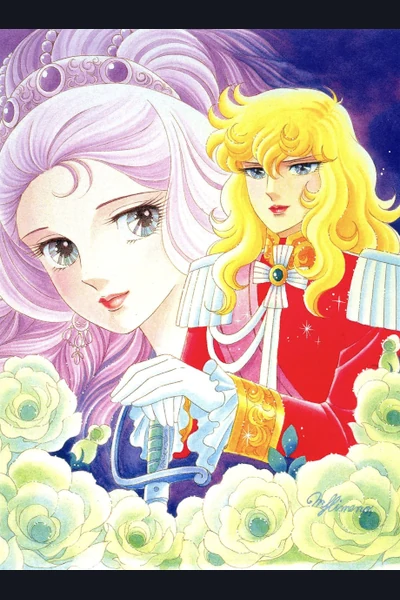
Oscar François de Jarjayes is a woman raised by her military father as his male heir and appointed commander of Marie Antoinette's Royal Guard. She enters Versailles in uniform, observes aristocracy consuming itself and spends years attempting to reconcile duty, identity and the increasingly audible approach of the French Revolution.
Riyoko Ikeda's manga ran in Shueisha's Margaret in 1972–73 and became a landmark of shojo manga. The 40-episode anime aired in 1979–80, with Osamu Dezaki directing much of its celebrated later stretch. Takarazuka musical productions, international adaptations and a modern animated feature have repeatedly returned to its roses and approaching guillotine.
Overview
The story begins around Marie Antoinette's arrival in France, her friendship with Oscar and disastrous affair with Swedish count Axel von Fersen. Oscar's childhood companion André Grandier loves her while class difference and political conscience reshape their relationship.
Ikeda uses fictional Oscar to cross court, military and revolutionary spaces. Historical events are compressed and dramatised, but the movement from luxury towards hunger remains clear. Versailles has excellent mirrors and very poor visibility beyond the gates.
Why it matters
Oscar became one of manga's defining gender-nonconforming heroines. She identifies as a woman while inhabiting a masculine military role, attracting women and men and exposing how costume, class and authority organise gender.
The work also helped prove shojo manga could carry history, politics and tragedy on an epic scale. Its flowers, stars and emotional tableaux are not decoration applied to serious material; they are the visual language through which seriousness is felt.
What to expect
Expect romance, political inequality, illness, violence and tragedy. The anime's theatrical style includes repeated imagery, dramatic stills and Dezaki's famous postcard memories. Historical accuracy is selective, emotional commitment absolute.
Gender and queer readings are central to the work's legacy, though the text comes from the 1970s and does not map neatly onto current terminology.
Adaptations and versions
The manga is concise and foundational. The 1979 anime expands events and gives the revolution accumulating weight. A 1979 live-action film directed by Jacques Demy is an unusual international interpretation; Takarazuka's stage versions became cultural institutions in their own right.
The newer animated film condenses the saga for another generation. Check current UK availability rather than assuming Versailles has opened all gates.
Where to start
Begin with the classic anime for atmosphere and full dramatic development, or the manga for Ikeda's original visual language. The film versions are best treated as complements, not substitutes for every turn of the court.
Verdict The SFcrowsnest take
The Rose of Versailles is grand melodrama with political teeth. Oscar's uniform, Marie's jewels and the roses around each declaration all exist beneath the shadow of bread prices and state violence.
Essential shojo history and still emotionally formidable. The revolution is coming; the programme has thoughtfully arranged the lighting.