Jujutsu Kaisen
Ordinary teenager eats a cursed finger, acquires the King of Curses as a permanent flatmate, and enrols in sorcery school; MAPPA's animators clearly forgot to sleep.
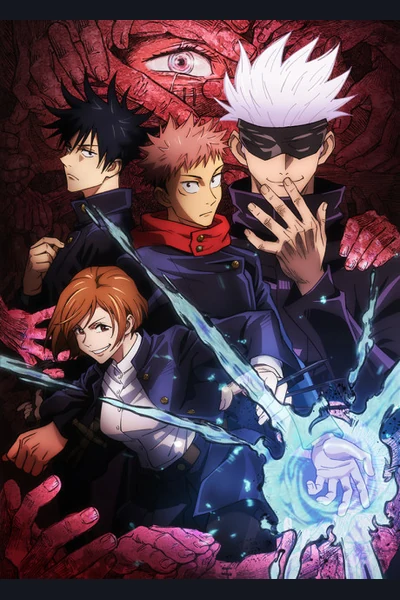
Jujutsu Kaisen begins when Yuji Itadori, an athletic schoolboy with an admirably uncomplicated moral compass, swallows a mummified finger. This is not a recommended route into further education. The finger belongs to Ryomen Sukuna, an ancient curse of spectacular unpleasantness, and Yuji becomes both his host and the proposed solution to a supernatural disposal problem: consume the remaining fingers, then be executed before Sukuna can redecorate civilisation.
Gege Akutami's manga ran in Shueisha's Weekly Shonen Jump from 2018 to 2024. Its title, 呪術廻戦, is generally left as Jujutsu Kaisen in English rather than subjected to a translation that would need several explanatory brackets. MAPPA's anime adaptation began in 2020, followed by the prequel film Jujutsu Kaisen 0 and further television arcs. Together they turned cursed energy, domain expansions and one extremely marketable blindfold into an international vocabulary.
Overview
In Akutami's world, human fear, hatred and misery leak into the environment as cursed energy, producing monsters that ordinary people cannot see but can still be killed by, which seems administratively unfair. Jujutsu sorcerers control that same energy to exorcise curses. Yuji enters Tokyo Jujutsu High under the care of Satoru Gojo, a teacher whose relaxed manner is supported by the inconvenient fact that almost nobody can make him stop being relaxed.
Yuji's classmates include Megumi Fushiguro, a sombre summoner with a dangerous sense of responsibility, and Nobara Kugisaki, who attacks curses with nails, a hammer and the confidence of somebody who has already rejected your excuse. The trio gives the early series a sturdy human centre. Around them sits a sorcerer establishment rich in secret techniques, old families, political cowardice and adults who consider sending teenagers into lethal basements a perfectly respectable educational model.
The series uses familiar battle-shonen architecture—missions, mentors, rival schools, named techniques and opponents who explain the rules while trying to remove your organs—but handles it with unusual speed. Akutami dislikes leaving the furniture where readers expect it. Alliances shift, certainties collapse and important characters discover that popularity is not contractual armour.
Why it matters
Jujutsu Kaisen arrived after decades of supernatural combat manga and makes no coy attempt to hide the ancestry. There are traces of Bleach, Yu Yu Hakusho, Hunter x Hunter and assorted school-for-dangerous-young-people stories in its bones. Its distinction lies in compression, tactical combat and an increasingly bleak examination of what institutions do to gifted children once those children become useful.
The power system is both a pleasure and a warning label. Cursed techniques can be wonderfully specific, while domain expansions turn personal abilities into enclosed statements of intent. At their best, the fights resemble violent legal arguments in which each participant searches for a loophole. At their most involved, the explanation may require ratios, inherited conditions and a flowchart wearing a small exorcist's uniform. Manga readers should not be ashamed to reread a page. The page has almost certainly reread you.
What gives the violence weight is Yuji's concern with a proper death. He cannot save everybody, but he wants people to die surrounded by meaning rather than used as material. The story repeatedly tests that belief against mass suffering, professional detachment and Sukuna's delighted contempt. It is not a cheerful examination, though Gojo's charisma and the cast's comedy prevent the darkness from becoming a permanent lighting failure.
What to expect
Expect fast supernatural action, body horror, sudden deaths and villains who regard civilians as available décor. The anime can be graphic, and later material is substantially darker than the school-adventure opening might suggest. Comedy is frequent early on, built from personality clashes and pop-culture nonsense, but it does not guarantee safety. Romance is barely on the timetable. Friendship, obligation, grief and the exploitation of talent take precedence.
MAPPA's adaptation gives the combat physical force: bodies carry momentum, environments break convincingly and the camera often finds a readable path through abilities that look ferociously complicated on paper. The production has also become associated with public discussion of animator workloads. That context deserves neutral acknowledgement rather than turning exhausted artists into another promotional statistic.
Adaptations and versions
The manga is the completed source and the clearest route for anyone unwilling to wait for animation. The television anime begins with Yuji's story. Jujutsu Kaisen 0 adapts Akutami's earlier prequel about Yuta Okkotsu and is best watched after the first television series, when its characters and institutions carry more weight. The second television series covers Gojo's student past before moving into the pivotal Shibuya Incident.
The anime is comparatively faithful but changes emphasis through performance, movement and expanded action. The manga is leaner and sometimes rougher, particularly when Akutami is hurrying towards the next collision. Neither version entirely solves the later story's appetite for technical explanation; one gives you time to inspect it, while the other gives it music and sends it through a building.
Where to start
Begin with manga volume one or anime episode one. The anime is the friendlier introduction because voices and choreography make the early ensemble immediately legible. Watch the first series, then Jujutsu Kaisen 0, then continue with the second series. Avoid starting with Shibuya simply because clips promise remarkable violence. A catastrophe is more effective after one has met the people being catastrophised.
Verdict The SFcrowsnest take
Jujutsu Kaisen is clever, propulsive and occasionally so pleased with the engineering of its power system that it forgets a reader may have come without graph paper. Its best qualities are harsher and simpler: vivid characters, excellent confrontations and a refusal to pretend that training young heroes for sacrificial work is noble merely because the uniforms are smart.
The anime supplies spectacle; the manga supplies the completed argument. Both reward attention and tolerate very little background viewing. Recommended for readers and viewers who like their supernatural battles tactical, their institutions suspect and their favourite characters treated with a level of contractual uncertainty normally reserved for freelance employment.