
Durarara!!
A headless Irish fairy on a black motorbike is just one thread in the tangled gang warfare of Tokyo's Ikebukuro; sprawling urban crime told from a dozen angles at once.
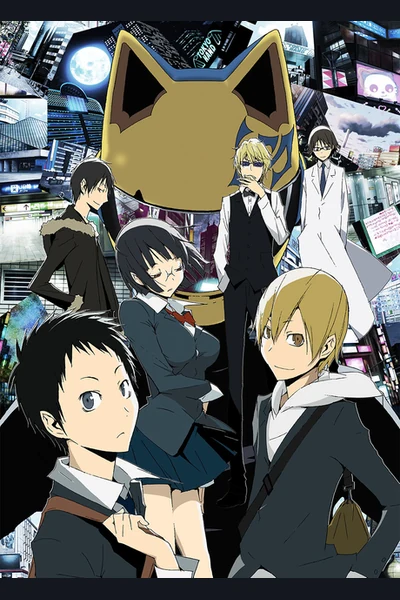
Overview
Durarara!! moves Ryohgo Narita's ensemble chaos from Prohibition America to Ikebukuro, where the gangs are modern, the rumours move at internet speed and the most striking motorcyclist in town happens to be a headless Irish fairy. This is urban fantasy by way of crime drama, social network fever dream and late-night city walk taken after making several poor decisions.
The plot circles a large cast: students, gang members, information brokers, stalkers, bartenders, criminals and supernatural outliers. Nobody owns the story for long. Instead, Ikebukuro itself becomes the main character, a district made of gossip, grudges and messages sent by people who really should know better.
Why it matters
Durarara!! captured a particular 2000s anxiety about cities and networks. Its supernatural elements are flamboyant, but much of its unease comes from very ordinary modern things: anonymous online spaces, youth gangs, celebrity obsession, urban loneliness and the way a rumour can become more powerful than fact once enough people need it to be true.
It also shows Narita refining the ensemble approach familiar from Baccano!. Here the collisions feel less like a train wreck and more like traffic patterns seen from a tower block: everyone appears to be moving independently until the design snaps into view.
What to expect
Expect a slow accumulation of incident rather than a simple hero's journey. Durarara!! begins with the oddness of Ikebukuro and gradually reveals how many of its citizens are pretending to be more normal than they are. The series likes reversals, hidden identities and characters who build elaborate reputations because reality has not been generous enough.
The tone can switch quickly. It has comic energy, supernatural cool and moments of genuine menace. Some material around obsession, manipulation and violence can be uncomfortable, particularly when the show peers into the psychology of people treating other human beings as narrative props in their own private dramas.
The headless rider, Celty, is often the secret emotional centre. She may be mythic, but she is also oddly practical, which is a splendid combination in a city where several supposedly normal people are absolute disasters.
Adaptations and versions
The property began as a light-novel series by Ryohgo Narita, later joined by manga versions and the well-known anime adaptation from Brain's Base. The anime's first season is the natural point of entry, followed by later continuation seasons if the city's peculiar social ecosystem has taken root.
As with many long-running light-novel franchises, the novels carry the broader continuity. The anime delivers the rhythm, voice cast and street-level atmosphere that made the series travel internationally.
Where to start
Start with the anime's first season. It gives the clearest sense of the show's appeal: Ikebukuro as a living rumour mill, with Celty's motorcycle threading through the traffic like folklore in a crash helmet.
If you enjoy the cast more than any single plotline, continue onward. Durarara!! rewards viewers who like watching relationships and deceptions accrue interest.
Verdict The SFcrowsnest take
Durarara!! is supernatural urban crime with a fine ear for the madness of crowds. It is messy, talkative and occasionally overstuffed, but that is also the point. This is a city story, and cities are rarely polite enough to keep to one plot at a time.