86 -Eighty-Six-
A nation fights a supposedly 'casualty-free' drone war by quietly crewing the drones with an oppressed underclass it refuses to count as human; military SF with a sharp political edge.
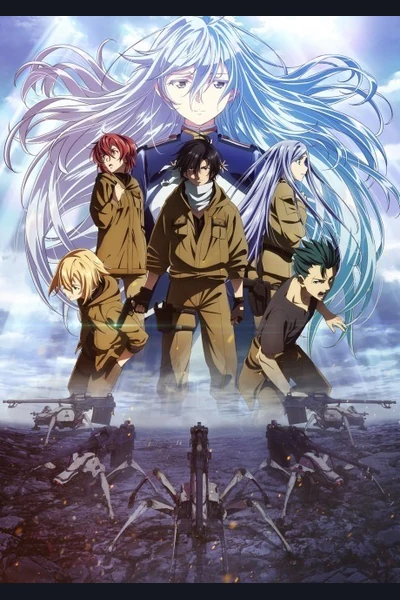
The Republic of San Magnolia announces that its war against the autonomous Legion is fought by unmanned drones and therefore produces no casualties. The machines are crewed by the Eighty-Six, an ethnic underclass stripped of citizenship and officially classified out of humanity. Nothing reduces the casualty figures like editing the definition of a person.
Overview
Asato Asato's light-novel series follows Vladilena “Lena” Milizé, an Alba officer who remotely commands the Spearhead Squadron, and Shinei “Shin” Nouzen, the unit's field leader in the segregated combat zone. Their Para-RAID communications allow voices to cross the wall between privilege and extermination, but empathy does not make their positions equal.
The Eighty-Six operate spider-like Juggernauts against an enemy force that may outlive the nations fighting it. Each mission erodes a group already expected to die quietly enough for the Republic to preserve its self-image.
Why it matters
86 turns the dishonest language of clean warfare into its central weapon. “Drones”, “processors” and “zero casualties” are bureaucratic spells used to make state violence disappear. The allegory is intentionally blunt; genocide rarely improves when made tasteful.
The story becomes strongest when it examines distance. Lena can care deeply and still return to safety after every call. Shin and his comrades must carry both the fighting and the emotional education of a well-meaning officer from the society persecuting them.
What to expect
Expect military action, battlefield death, racism, forced conscription, suicide, survivor's guilt and children made responsible for an adult civilisation's crimes. The mecha are low, vulnerable machines rather than invincible metal knights. Combat is confusing and fast because that is how people die in it.
There is romance and tenderness, but grief sets the rhythm. Names, voices and personal objects matter intensely in a system designed to turn people into numbers. The politics sometimes simplify oppressor and victim societies into broad blocks, yet the emotional consequences remain sharp.
Adaptations and versions
The light novels are the source and continue beyond the material covered by the initial television run. A-1 Pictures' anime uses composition, music and visual parallels with exceptional care, often creating meaning from the physical separation of its two leads.
Manga adaptations exist but are secondary routes and do not replace the novels as the continuing source. Anyone moving from anime to prose should check which novel volume follows the adapted arc rather than assuming matching publication numbers.
Where to start
Begin with the anime. Its direction turns conversations across distance into proper cinema and gives the squadron room to become individuals. Choose the novels for the fullest world, internal voices and continuation.
Verdict The SFcrowsnest take
86 is furious military science fiction disguised beneath immaculate production. Its symbolism occasionally arrives wearing a name badge, but subtlety is not the only route to truth. What matters is that every erased casualty regains a face, a joke and a voice. The Republic's machines may be unmanned; its lies certainly are not.