Dragon Ball
A man gets stronger primarily by shouting very loudly; the template every shonen since has politely traced over. The late Akira Toriyama is much missed.
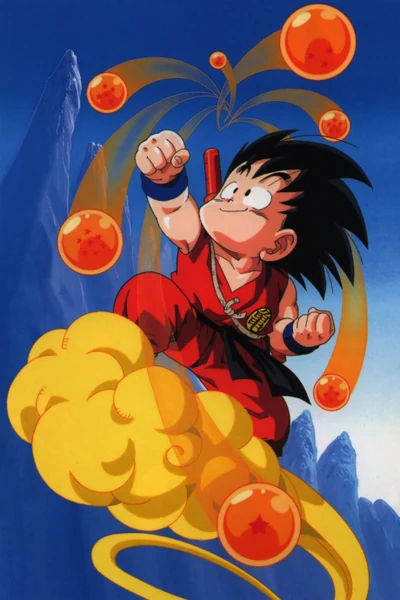
Before Dragon Ball became synonymous with airborne martial artists shouting at the weather, it was a comedy adventure about a monkey-tailed boy, a teenage inventor and seven wish-granting balls. Son Goku had superhuman strength, no social education and a touching willingness to judge strangers entirely by whether they fed him or wanted a fight. Often both.
Akira Toriyama's manga ran in Shueisha's Weekly Shonen Jump from 1984 to 1995 and was collected in 42 volumes. Japanese television divided the adaptation into Dragon Ball and Dragon Ball Z, with later branches including GT, Kai, Super and Daima. International releases rearranged titles, edits and dubs so thoroughly that two fans can say they grew up with Dragon Ball and mean rather different childhoods.
Overview
The opening draws freely from Journey to the West. Goku travels with Bulma in search of the Dragon Balls, meeting shapeshifting animals, desert bandits, martial artists and organisations whose military ambition is undermined by their uniforms. Tournaments gradually move combat to the centre. The cast grows, former enemies become allies and Goku matures from feral child into an adult whose parenting remains less developed than his upper-body strength.
The material commonly branded Dragon Ball Z widens the story into science fantasy. Aliens, androids, time travel and planet-destroying enemies arrive. Battles grow longer, transformations multiply and death becomes a serious event with a surprisingly flexible returns policy.
Why it matters
Modern battle shonen did not begin with Dragon Ball, but much of its popular grammar was fixed here: training arcs, tournament brackets, friendly rivals, escalating forms and heroes who respond to impossible odds by treating them as exercise. Later manga have complicated or criticised the formula; they still tend to find Toriyama's fingerprints on the equipment.
His art is the deeper reason. Toriyama makes action readable. Bodies move through space with weight and direction, vehicles appear mechanically plausible despite being shaped like sweets, and complicated exchanges remain clear at speed. The apparent simplicity is expert design wearing comfortable shoes.
The late Akira Toriyama's death in 2024 gave the franchise's global affection a painful new context. His influence extends beyond manga into games and visual culture, but Dragon Ball remains the most direct expression of his gift for combining clean invention with cheerful foolishness.
What to expect
Early Dragon Ball is comic, adventurous and occasionally burdened by sexual jokes that have aged with all the grace of milk near a radiator. Later material emphasises combat, sacrifice and cosmic threat. Violence is stylised but intense; characters are beaten, impaled and killed, although resurrection prevents mortality from maintaining absolute authority.
Romance occurs largely as a route to the next generation. Friendship, rivalry and appetite matter more. The series' repetition is part ritual, part weakness: new enemy, new limit, new hair arrangement. Yet Toriyama's humour repeatedly punctures the grandeur before it becomes entirely self-important.
Adaptations and versions
The original manga is one continuous work and the most elegant route. The anime begins with Dragon Ball, continues through Dragon Ball Z, and can be followed by later series according to interest. Dragon Ball Kai is a recut of Z with reduced filler and revised presentation, useful for viewers who prefer their apocalyptic battles with fewer episodes of charging.
Dragon Ball GT is an anime-original sequel with striking ideas and disputed execution. Dragon Ball Super continues after the original ending through anime, manga and films with some differences between versions. Dragon Ball Daima offers another late Toriyama-conceived adventure. Check current release order and availability, because this family tree has learned fusion.
Where to start
Start with manga volume one or the original Dragon Ball anime, not Z, if you want to understand the cast and Toriyama's comic voice. Viewers interested chiefly in famous battles can begin with Z or Kai, but will miss the period when Piccolo and Krillin were allowed to be terrifying and relevant respectively.
Verdict The SFcrowsnest take
Dragon Ball is foundational without being a museum piece. Its scale became ridiculous, its solutions increasingly depended on training and its chronology now requires cautious handling. Beneath that sits a beautifully drawn adventure about testing oneself, making rivals into friends and eating enough afterwards to alarm an agricultural ministry.
The manga is the essential version; the anime is the cultural megaphone. Start at the beginning if possible. Goku gets stronger by effort, talent and occasional shouting, but the franchise endured because Toriyama made the journey funny enough to survive the destination.