
Demon Slayer: Kimetsu no Yaiba
A kind-hearted charcoal-seller has the worst commute home in history and channels his grief into becoming a sword-swinging demon exterminator; ufotable animate it so beautifully you'll forgive the sheer volume of weeping.
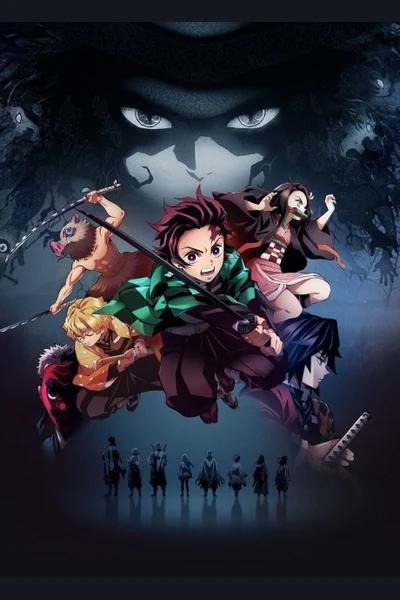
Demon Slayer: Kimetsu no Yaiba is the story of an exceptionally decent boy discovering that the universe has rewarded his good character by murdering most of his family and turning his sister into a demon. This would be enough to make many protagonists cultivate a black cape and an exhausting philosophy. Tanjiro Kamado instead packs Nezuko into a box, learns swordsmanship and sets off to find a cure. He is angry with the monsters, certainly, but remains inconveniently capable of pitying them. It is a small distinction on which the whole enormous franchise turns.
Created by Koyoharu Gotouge, the manga ran in Shueisha's Weekly Shonen Jump from 2016 to 2020 and was collected in 23 volumes. Its Japanese title is Kimetsu no Yaiba (鬼滅の刃). The anime adaptation, made by ufotable, began in 2019 and transformed a successful manga into the sort of cultural event that produces cinema queues, patterned coats on every convention floor and parents learning far more about breathing techniques than they had expected.
Overview
The setting is Taisho-period Japan, although this is history with demons under the floorboards and secret swordsmen conducting a private war after dark. Tanjiro earns a place in the Demon Slayer Corps, whose members use specialised breathing styles and Nichirin blades against creatures that recover from most injuries with the smug efficiency of a cancelled direct debit returning the following month.
The broad machinery is familiar battle-shonen equipment: training, ranked enemies, distinctive fighting disciplines, eccentric comrades and increasingly alarming opponents. Gotouge did not invent this cupboard of ingredients. The achievement lies in the recipe. Tanjiro is strong without becoming a swaggering appetite in trousers; Nezuko remains emotionally central rather than serving merely as the hero's tragic luggage; and the demons are often granted enough remembered humanity to make their destruction feel necessary without feeling uncomplicated.
That compassion is also the series' most recognisable habit. A battle may conclude with a cleanly severed neck, after which the narrative pauses to explain how the monster arrived at this miserable point. Sometimes the result is genuinely moving. Sometimes it resembles being handed a complete case file while the body is still rolling downhill. Either way, Demon Slayer is less interested in declaring evil mysterious than in showing how suffering, appetite and abuse can turn people into engines that pass suffering onwards.
Why it matters
The manga was already a substantial success, but ufotable's adaptation gave it another order of visibility. The studio combines crisp character animation, elaborate compositing, painted effects and mobile camerawork without losing Gotouge's stranger facial expressions or sudden descents into broad comedy. Its major battles have the sheen of prestige animation while still understanding that spectacle without emotional preparation is merely an expensive screensaver.
The 2020 feature Demon Slayer: Kimetsu no Yaiba – The Movie: Mugen Train turned that momentum into a box-office phenomenon, breaking records in Japan and elsewhere during a period when cinemas were hardly enjoying ideal working conditions. More importantly for the series itself, the film demonstrated that an arc from a continuing television anime could operate as a major theatrical release without pretending to be a disposable side adventure. The industry noticed. Industries are very observant when money arrives carrying a sword.
Yet the popularity is not entirely a triumph of presentation. Beneath the lacquer, Demon Slayer is unusually earnest about family, grief and kindness. It does not regard sincerity as an embarrassing fluid to be wiped away before the next action sequence. Tanjiro's empathy is tested rather than mocked, and Nezuko's condition keeps the central question personal: can someone touched by monstrosity retain agency, affection and moral worth? The series asks this repeatedly, occasionally with subtlety and occasionally while somebody explains it at considerable volume.
What to expect
This is accessible anime, not gentle anime. The plot is easy to follow and the emotional stakes are established quickly, making it a sound entry point for viewers who have never memorised a Shonen Jump power hierarchy. The violence, however, is frequent and sometimes grisly: decapitation is the standard solution to a demon problem, bodies are altered or dismembered, children are endangered and death is not kept behind a tasteful screen. Check the current UK classification before offering it as family entertainment simply because the merchandise includes small plush characters.
The tone moves between horror, tragedy, action and comedy with very little customs inspection. Tanjiro supplies steadiness; the boar-headed Inosuke supplies magnificent social malfunction; Zenitsu supplies panic at a pitch that will either become endearing or cause nearby glassware to seek legal advice. The comedy is deliberately broad and can arrive immediately after dark material. Romance exists mostly at the edges. Family bonds, friendship and duty occupy the centre.
Visually, the manga and anime offer different pleasures. Gotouge's drawing can be rough, elastic and intensely expressive, particularly in faces and moments of panic. The anime is smoother, more sumptuous and easier to sell by the trailer frame. Readers who prefer the texture of an individual artist's line may find the manga more intimate; viewers who want music, performance and fights turned into moving tapestries will understand why ufotable's name became inseparable from the property.
Adaptations and versions
The manga is complete, which makes its route admirably civilised: begin at volume one and continue until volume 23. The anime follows the main story in order but has been divided among television arcs and films, with some material appearing in more than one form.
Start with the first television series, commonly labelled the Tanjiro Kamado, Unwavering Resolve Arc. Continue with Mugen Train, choosing either the theatrical film or its television recut; watching both is optional unless comparing edits is your preferred form of evening exercise. The television version adds an opening episode and restructures the film material for broadcast. After that come the Entertainment District, Swordsmith Village and Hashira Training arcs. The concluding Infinity Castle material is being handled theatrically; release dates and UK availability should be checked when this page goes live, because distribution schedules enjoy making evergreen guides look foolish.
There are also games, stage productions, compilation screenings and assorted merchandise, but none is required to understand the principal story. The manga and ufotable anime are the load-bearing versions. Everything else may be approached according to enthusiasm, available shelf space and one's tolerance for paying to unlock another digital sword technique.
Where to start
For most newcomers, the 2019 anime is the easiest entrance. Its opening episodes establish Tanjiro, Nezuko, the Corps and the rules with unusual efficiency, and the production gives the emotional turns room to land. Continue in release order and do not leap directly to whichever battle currently dominates social media; the beautiful explosion works better when you know why everyone is upset.
Choose the manga instead if you prefer a completed story, faster progress or Gotouge's less polished but more personal visual language. It is also the sensible route for anyone who reaches the end of the available animation and discovers that patience was not among their breathing forms. Neither version invalidates the other. The anime expands and embellishes; the manga supplies the original rhythm and the certainty of an ending.
Verdict The SFcrowsnest take
Demon Slayer is not subtle, and it has never mistaken restraint for a compulsory virtue. It cries, shouts, bleeds and explains itself, sometimes within the same minute. What saves it from becoming a beautifully animated delivery system for escalating sword attacks is its stubborn moral centre. Tanjiro's kindness is not a decorative character trait but the point of the exercise, set against villains who have allowed pain to become permission.
The anime is the grander spectacle; the manga is the leaner and more idiosyncratic work. Together they form an unusually welcoming gateway into modern battle shonen: violent but compassionate, formula-conscious without being hollow, and visually extravagant enough to make fire and water curl around a blade as though the elements themselves had joined the production committee. It belongs in the cultural trophy cabinet, although perhaps on a reinforced shelf. There are 23 volumes, several swords and rather a lot of unresolved grief to support.