
Baccano!
Mafiosi, alchemists and immortals collide aboard a transcontinental express in Prohibition-era America; a gleefully violent, time-scrambled crime ensemble where nobody quite stays dead.
Overview
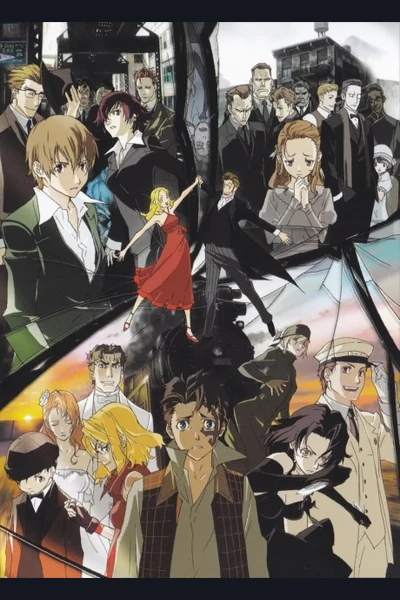
Baccano! is what happens when a Prohibition gangster story is handed a bottle of immortality elixir, shaken violently and thrown down the corridor of a speeding train. Ryohgo Narita's light-novel series begins as a cheerful affront to linear storytelling, scattering mobsters, alchemists, thieves, killers and the occasional unnervingly resilient bystander across 1930s America. The result is less a tidy plot than a spectacular railway accident of motives.
The famous anime adaptation by Brain's Base understands the assignment beautifully. It does not invite the viewer in with a polite handshake. It kicks open the carriage door, introduces too many people at once and trusts you to enjoy catching up. For some viewers, that is bliss. For others, it may feel like being asked to solve a crossword while someone fires a tommy gun nearby.
Why it matters
Baccano! is one of the better examples of anime using structure as personality. Its time-jumps are not merely decoration. They make the cast feel like parts of a larger machine, each character convinced they are the lead in a different genre. There is gangster noir here, black comedy, occult science fiction, train thriller and splatter farce, all jostling for elbow-room.
It also helped establish Narita's fondness for crowded urban ecosystems, where the fun lies not in one heroic destiny but in watching social chaos develop its own weather. If Durarara!! is his Tokyo street map, Baccano! is the bootlegger's ledger written in blood and stage directions.
What to expect
Expect violence, but not much solemnity. Baccano! can be grisly, yet it has the buoyant rhythm of a pulp serial that knows death has become administratively complicated. Characters laugh too loudly, fight too theatrically and survive in ways that would cause a coroner to start drinking.
The charm comes from the ensemble. Isaac and Miria, the story's magnificent double-act of criminal idiocy, may be worth the fare alone. Around them orbit far nastier specimens: killers, manipulators, family men with terrifying day jobs and immortals carrying old grudges like unpaid hotel bills.
Viewers who need a clear central protagonist may find it evasive. Viewers who like mosaic storytelling will discover a series with the confidence to leave pieces upside down until the last possible moment.
Adaptations and versions
The original work is a light-novel series by Ryohgo Narita, with manga adaptations also attached to the property. The 2007 television anime remains the best-known screen version, animated by Brain's Base and often praised for compressing a sprawling narrative into something brisk, stylish and admirably unhinged.
As ever with light-novel properties, rights and availability can be more complicated than the plot. The anime is the cleanest starting point for most people, but the novels offer more breadth for anyone who wants the full tangle of immortal criminals and criminal immortals.
Where to start
Start with the anime if you want the immediate impact: music, timing, gunfire, train wheels and Narita's cast colliding at speed. Give it a few episodes before deciding whether the apparent confusion is a flaw. In Baccano!, confusion is more of a house style.
If the anime clicks, the novels are the logical next stop. They give the world more room to misbehave and make clearer how deliberate the overlapping chronology is.
Verdict The SFcrowsnest take
Baccano! is a gloriously over-populated supernatural crime caper, full of noise, blood and people who really should not be trusted with eternal life. It is not elegant in the porcelain sense. It is elegant in the sense of a knife trick performed on a moving train by someone grinning far too widely.