
Appleseed
Shirow's cyberpunk cousin to Ghost in the Shell: gun-toting cyborgs, fragile post-war utopias and reams of philosophy crammed into the margins. ESWAT never looked sharper.
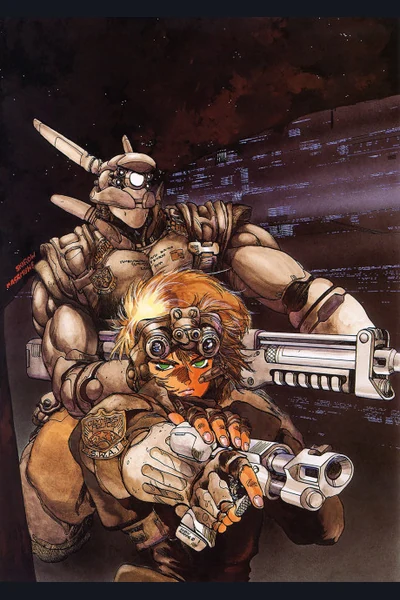
After a global war, soldier Deunan Knute is brought to Olympus, a planned city governed with the assistance of genetically engineered Bioroids. Her former partner Briareos Hecatonchires is already there, now heavily cybernetic but still recognisably the man beneath the hardware. Olympus appears peaceful, rational and well maintained, which in political science fiction means somebody should inspect the foundations.
Masamune Shirow's manga began in 1985 and was collected in four main volumes, though its larger story remains unfinished. Several anime versions followed: a 1988 OVA, the 2004 computer-animated film Appleseed, 2007's Ex Machina, the Appleseed XIII series and 2014's Appleseed Alpha.
Overview
Deunan and Briareos join ESWAT, Olympus's elite security force. They confront terrorism, political factions and questions created by a society in which Bioroids manage human aggression while possessing limited reproductive and emotional autonomy.
Shirow fills the manga with tactical hardware, political argument and explanatory notes that can become a second publication running beneath the panels. Readers wanting only powered armour may discover the armour has arrived with constitutional theory.
Why it matters
Appleseed shares concerns with Shirow's later Ghost in the Shell: cybernetic identity, security, technology and the state. It is brighter and more utopian on the surface, which makes its doubts about engineered peace particularly useful.
Deunan and Briareos form an unusually durable adult partnership. His cyborg body is neither a simple tragedy nor a superhuman upgrade; it changes intimacy, risk and how institutions see him. Their relationship keeps the political machinery attached to human consequence.
What to expect
Expect gun battles, terrorism, cyborg injury, political debate and dense military technology. The manga includes nudity and fanservice characteristic of Shirow's work. Adaptations simplify the politics and vary greatly in visual style.
The 2004 film's cel-shaded computer animation was ambitious and visibly of its period. Ex Machina, produced with John Woo involvement, adds polished action and an increased likelihood of characters firing two weapons when one would have met workplace requirements.
Adaptations and versions
The 1988 OVA is a loose, compact adaptation. The 2004 film and Ex Machina form one screen line. Appleseed XIII retells material as a series, while Alpha offers a pre-Olympus version of Deunan and Briareos.
None captures the manga's complete political texture. Treat them as variations, not sequential chapters unless explicitly paired.
Where to start
Read manga volume one for Shirow's actual work. For animation, try the 2004 film followed by Ex Machina, or Alpha for a more accessible standalone action story. Do not expect a single definitive adaptation; Olympus has several planning committees.
Verdict The SFcrowsnest take
Appleseed is cyberpunk's more optimistic cousin, though the optimism arrives armed and under surveillance. Its questions about designed citizens, managed aggression and benevolent authority remain unpleasantly current.
The manga is the essential version: brilliant, cluttered and unfinished. The films offer impressive fragments of a utopia forever discovering another systems fault.