
20th Century Boys
Childhood friends realise a doomsday cult is enacting the world-ending story they invented as kids; Urasawa's paranoid, time-hopping mystery at its most addictive.
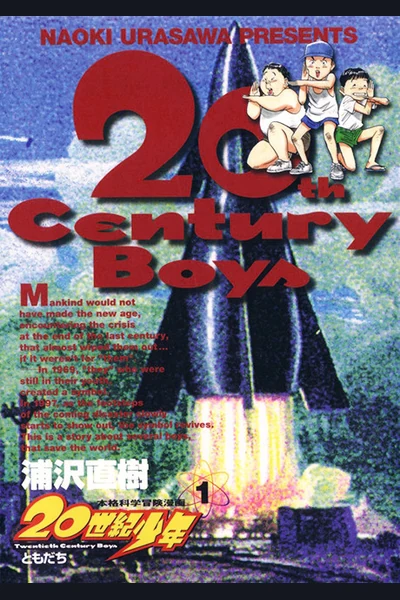
In 1969, a group of boys invent a symbol, a secret base and a story in which villains attack the world before their heroic younger selves save it. Decades later, convenience-store manager Kenji Endo notices a cult led by a masked figure called Friend using the same symbol and following the childhood scenario. The apocalypse has found their old notebook and appears to be treating it as a project plan.
Naoki Urasawa's manga ran in Shogakukan's Big Comic Spirits from 1999 to 2006 and filled 22 volumes. The two-volume 21st Century Boys completes the story. A Japanese live-action film trilogy released from 2008 to 2009 attempted the considerable feat of fitting the conspiracy into cinemas without requiring patrons to renew their seats.
Overview
Kenji gathers childhood friends to remember who knew their game and what they may have forgotten. The narrative moves among the 1960s, late 1990s and later futures, following ordinary people as Friend turns nostalgia, fear and spectacle into political authority.
Memory is evidence and liability. Children misremember; adults revise. Urasawa repeatedly shows an event from another angle until the secure version begins looking suspicious around the edges.
Why it matters
The series is a masterclass in serial suspense: symbols, songs and minor faces return after long absences with altered meaning. Urasawa gives the conspiracy scale without abandoning shopkeepers, teachers and failed musicians caught inside it.
Friend's power grows through performance. The cult sells belonging, appropriates childhood heroism and stages threats from which it can offer rescue. The political mechanism has not become less recognisable since publication.
What to expect
Expect murder, terrorism, epidemics, authoritarian rule and child trauma. The cast is enormous and chronology shifts often; careful reading is rewarded. Comedy and music provide warmth, particularly through Kenji's abandoned rock ambitions.
The mystery's final explanations divide some readers and require 21st Century Boys. Stopping at volume 22 is leaving the evidence room before the last folder arrives.
Adaptations and versions
The manga is the essential version. Perfect Edition volumes incorporate 21st Century Boys into the sequence and may contain revised presentation.
The live-action trilogy is impressively cast and visually faithful but compresses people and subplots. It works best after the manga, when recognition can compensate for speed. No anime adaptation currently defines the property.
Where to start
Begin with manga volume one and avoid identity spoilers. Read through 21st Century Boys. The films can follow as an ambitious companion piece.
Verdict The SFcrowsnest take
20th Century Boys turns childhood imagination into political evidence and asks who owns the stories adults inherit from themselves. Its plot is vast; its fear remains intimate—the possibility that something forgotten still remembers you.
Urasawa at his most compulsive. Keep the symbol off promotional stationery.