'Repent, Harlequin!' Said the Ticktockman
Hugo and Nebula winner, and one of the most reprinted SF stories ever written — the genre's definitive fable of civil disobedience.

The essential authors of science fiction, fantasy & horror — and where to start reading them.
Book Entry · Science Fiction
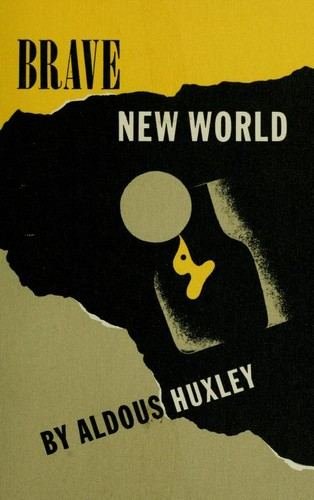
A.F. 632: humanity is decanted, not born — Alphas to Epsilons designed to love their stations, conditioned by hypnopaedia, pacified by soma, entertained by the feelies and obligatory promiscuity, with history ('bunk') safely abolished. Into this perfectly happy world come its two failures: Bernard Marx, an Alpha with a suspected alcohol-in-the-blood-surrogate chip on his shoulder, and John the Savage, Shakespeare-reared on a New Mexico reservation, whose collision with civilisation builds to his debate with World Controller Mustapha Mond — the book's true climax, where comfort and freedom state their cases and are both heard. John claims the right to be unhappy; the world declines to need it.
One of the two definitive dystopias of the century, the necessary complement to Orwell: control by pleasure rather than pain. Its reproductive technologies and engineered castes have kept it permanently, uncomfortably current.
Prefer Amazon? Buying through these links may earn SFcrowsnest a small commission, at no extra cost to you.
Buy on Amazon UK → Buy on Amazon US →As an Amazon Associate, SFcrowsnest earns from qualifying purchases.
Hugo and Nebula winner, and one of the most reprinted SF stories ever written — the genre's definitive fable of civil disobedience.
The most effective political allegory in the language, permanently in print and on syllabuses worldwide; with Nineteen Eighty-Four it made Orwell's name an adjective.
The definitive vertical-dystopia novel, endlessly cited in architecture and sociology as well as fiction; filmed by Ben Wheatley in 2015 with Tom Hiddleston.