Author Profile · Science Fiction & Fantasy
Edgar Rice Burroughs
1875–1950 · American
Who was Edgar Rice Burroughs?
A failed pencil-sharpener wholesaler who, at thirty-five, decided he could write worse rubbish than the pulps were already printing and get paid for it. He was magnificently wrong about the 'worse' part: from 1912 he produced Tarzan, John Carter of Mars, Pellucidar's inner world and Carson of Venus at industrial speed, becoming one of the bestselling authors on the planet and incorporating himself so efficiently that the town of Tarzana, California, is named after his ranch. Burroughs's plotting runs on coincidence and his heroes on chivalry, but nobody before or since has delivered pure escapist momentum with such shameless, irresistible confidence.
Why they matter
The father of planetary romance. Barsoom fired the imaginations of the scientists and writers who built both the space programme and modern SF — Carl Sagan, Bradbury and Heinlein all paid tribute — and the John Carter DNA is plainly visible in Star Wars and Avatar.
Essential books — and where to start
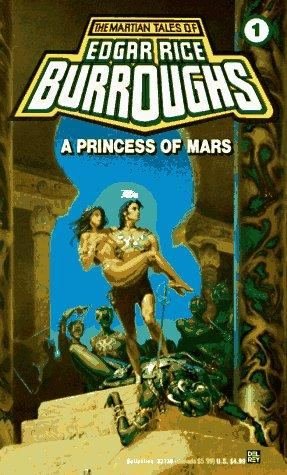
1912 · Barsoom, book 1 · Science Fiction · Planetary Romance, Science Fantasy
Confederate veteran John Carter, hiding from Apaches in an Arizona cave, is mysteriously projected to Mars — Barsoom to its inhabitants — where the lower gravity makes him a superman among the towering Green Martians. He rises through the warrior society of the Tharks, falls for the red-skinned, egg-laying and resolutely humanoid princess Dejah Thoris of Helium, and saves a dying planet whose atmosphere runs on a single failing factory. First serialised in 1912 as 'Under the Moons of Mars', it set the pulps alight.
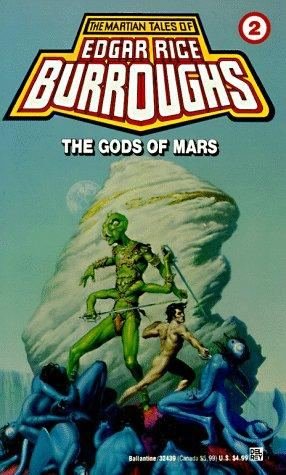
1913 · Barsoom, book 2 · Science Fiction · Planetary Romance, Science Fantasy
Carter returns to Barsoom after ten years' exile and materialises in the Valley Dor, the Martian heaven to which the devout sail down the river Iss — and which turns out to be a slaughterhouse run by the white-skinned Therns and the black pirates of the moon, with a false goddess at the top of the pyramid. Burroughs gleefully demolishes his invented planet's religion in an adventure of arena fights, aerial battles and audacious escapes, ending on the most notorious cliffhanger in pulp history.
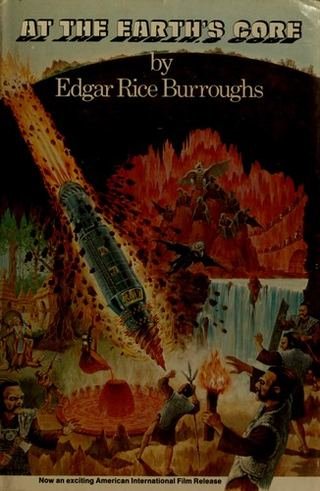
1914 · Pellucidar, book 1 · Science Fiction · Planetary Romance, Science Fantasy
Mining heir David Innes and inventor Abner Perry test a mechanical 'iron mole' that burrows out of control and delivers them to Pellucidar, the world on the inner surface of the hollow Earth, lit by a tiny central sun under which time itself misbehaves. Humanity there is prey: the ruling Mahars are telepathic flying reptiles who farm people for food. Innes sets about organising the human tribes into an empire of revolt, pausing frequently for Burroughs's trademark abductions, pursuits and reunions.
Series
1926–2011 · American-Irish
The bridge between SF and fantasy readerships and the genre's great gateway author for young readers — particularly girls, whom the field had largely ignored.
1912–2005 · American
Quietly one of the most influential figures in the field: she trained the readership.
1916–2013 · American
The genre's supreme stylist and a double founder: of the Dying Earth subgenre (Wolfe's Book of the New Sun is its godchild) and of anthropological planetary adventure.
