
Tengen Toppa Gurren Lagann
Dig a tunnel, find a buried giant robot, punch your way to the surface and then to the edge of the universe; the most gloriously over-the-top mecha series ever made, powered by sheer bloody-minded willpower.
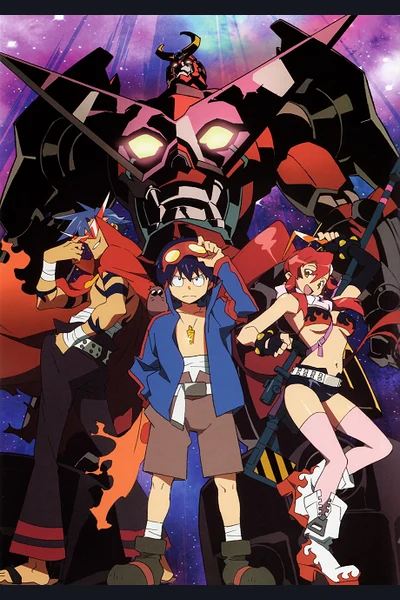
Simon digs tunnels beneath an underground village because that is what humanity does now. His magnificently self-confident friend Kamina believes a surface world exists and regards geology as a personal insult. The discovery of a small robot with a drill allows them to test both propositions rather noisily.
Overview
Gainax's anime-original Gurren Lagann, directed by Hiroyuki Imaishi, begins with two boys breaking out of a hole and proceeds to increase its scale until ordinary measurement files a grievance. Simon, Kamina and sharpshooter Yoko join rebels fighting beastmen in gunmen—giant robots whose faces are also their torsos, because aerodynamics has been excused.
Its famous rhetoric celebrates impossible confidence, but the series belongs to Simon, whose uncertainty gives all that shouting somewhere human to land. Growth is not the absence of fear or grief. It is learning which borrowed voices can become one's own.
Why it matters
The show is a love letter to super-robot history and a declaration that exuberance need not be stupid. Drills symbolise evolution, creation and the refusal to remain confined. Escalation becomes a philosophy: each ceiling is real until somebody reaches it.
This visual and emotional vocabulary helped define the creators who later formed Studio Trigger. Its influence survives in anime that stretch bodies, colour and common sense in pursuit of kinetic truth.
What to expect
Expect reckless battles, rallying speeches, grief, comedy and escalation so extreme that early giant robots eventually seem like sensible family hatchbacks. The animation varies deliberately between tight spectacle and expressive distortion; one early episode's stylistic departure remains conspicuous, though hardly fatal.
Yoko is capable and crucial, but the camera subjects her teenage body to persistent fan-service. Masculine bravado is interrogated more thoughtfully than the visual treatment of women, a limitation worth carrying alongside the affection.
Adaptations and versions
The 27-episode television anime is the source and proper starting point. Two compilation films retell its major halves with cuts, alterations and newly animated climactic material. They work best as celebratory revisits, not replacements for the character development removed to fit the running time.
Manga and novel adaptations followed the anime. They are supplementary routes rather than prior canon.
Where to start
Begin with television episode one and allow several episodes for the show's emotional design to emerge beneath Kamina's volume. Watch the films afterwards if the phrase “even larger final battle” sounds like a public service.
Verdict The SFcrowsnest take
Gurren Lagann has the restraint of a firework factory struck by inspirational lightning. Yet its excess works because Simon's journey gives it weight. Beneath the drills, galaxies and bare-chested declarations is a serious idea: hope is not certainty, but the decision to move while certainty is unavailable. Sometimes the subtle tool really is an enormous robot fist.