
No Game No Life
A pair of unbeatable shut-in siblings are dropped into a world where everything is settled by games, and proceed to cheat their way towards godhood; gleefully clever isekai.
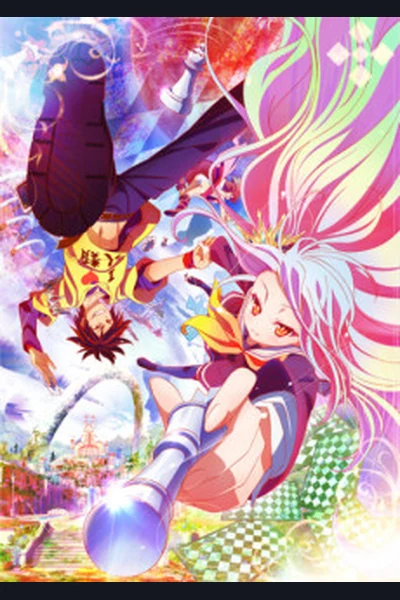
Shut-in siblings Sora and Shiro are collectively unbeatable online under the name Blank, although ordinary life has defeated them through lack of interest. A god named Tet summons them to Disboard, where violence is forbidden and every dispute—from property law to national sovereignty—is settled by games. At last, foreign policy has terms and conditions somebody might read.
Overview
Yuu Kamiya's light novels give Disboard ten absolute pledges governing competition. Cheating is not impossible; it merely becomes another system to understand. Sora excels at psychology and bluffing, Shiro at calculation, and together they intend to raise humanity from last place among the world's intelligent races before challenging Tet.
Their contests range from cards and chess-like warfare to games whose true rules emerge only after play begins. Victory depends less on luck than preparing several explanations for why Blank appeared to be losing.
Why it matters
The series distils power fantasy into intellectual theatre. Its heroes cannot solve conflict through physical force, so each arc constructs a puzzle around culture, information and the opponent's assumptions. The exuberant visual design makes thought processes feel like action set pieces.
At its best, No Game No Life also understands that rules are political. Whoever defines the game has already shaped its outcome. Humanity's weakness forces Sora and Shiro to treat cooperation, deception and representation as national resources.
What to expect
Expect rapid explanations, reversals, saturated colour, comic arrogance and games whose logic is more dramatic than tournament-certified. Blank's near-infallibility reduces suspense unless the pleasure of watching an elaborate trap close is enough.
The substantial reservation is sexualisation. Shiro is eleven, yet the anime and source material repeatedly use voyeuristic angles and jokes involving her body; other female characters receive similar treatment. Incest-adjacent humour around the siblings adds another grubby layer. Clever plotting does not neutralise this, and many viewers will reasonably decide the price is too high.
Adaptations and versions
The light novels are the principal source. Madhouse's television series adapts the opening volumes with an ending tease rather than a complete resolution. Manga versions cover portions of the same material at a different pace.
The film No Game No Life Zero is a distant prequel about the war before Tet's peaceful rules. It carries a darker tone and stronger standalone emotional arc, but its setting makes more sense after the television series has explained Disboard.
Where to start
Begin with the television anime if its visual invention and game mechanics appeal, then continue through the light novels for further contests. Watch Zero after the series. Prospective viewers bothered by sexualised child imagery can safely treat that warning as decisive rather than awaiting improvement.
Verdict The SFcrowsnest take
No Game No Life is ingenious game fantasy continually tripping over its own camera. The rules, colours and reversals can be exhilarating; the treatment of Shiro is indefensible and inseparable from the experience. There is a sharp series here about power and play. Unfortunately, nobody invoked a pledge against fan-service involving children.