
Mushoku Tensei: Jobless Reincarnation
A reclusive man is reborn into a fantasy world and resolves, this time, to actually live; sumptuous, often uncomfortable, the isekai that took itself seriously.
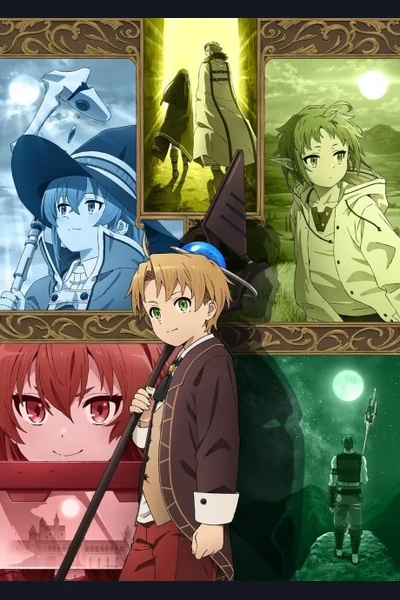
An unemployed, traumatised Japanese recluse dies and is reborn as Rudeus Greyrat in a fantasy world, retaining his adult memories inside an infant body. He resolves to use the second life properly: study magic, form relationships and stop hiding from existence. The difficulty is that he has also brought his appetites and failures with him, several of which should have been stopped at customs.
Rifujin na Magonote began the web novel in 2012; a light-novel edition followed, along with manga adaptations. Studio Bind was established around the long-term anime production, which began in 2021. The series is frequently called an influential modern isekai, both for its detailed life-spanning structure and for arguments about whether depicting reprehensible behaviour amounts to adequately confronting it.
Overview
Rudeus grows up with unusual magical talent in the household of Paul and Zenith Greyrat. Tutors and companions—including the demon mage Roxy, fierce noble girl Eris and gentle childhood friend Sylphie—shape his education. A large-scale displacement disaster scatters people across the world, turning an advantaged second childhood into a dangerous journey.
The fantasy setting receives patient attention: languages, travel, class, magic, family and regional cultures develop over years. Rudeus's body matures while the adult internal voice preserves the uncomfortable discontinuity between appearance and experience.
Why it matters
The series treats reincarnation as a whole-life project rather than a quick character upgrade. Skills require practice, journeys take time and actions affect relationships. Studio Bind's animation gives landscapes, domestic routines and magic unusual care, making the world feel inhabited before it needs to become spectacular.
Rudeus's growth is the intended centre. He learns courage, responsibility and attachment after a first life defined by withdrawal. The central controversy is whether the story applies the same moral seriousness to his sexual behaviour. Voyeurism, harassment and attraction involving minors are often framed comically or indulged, and later improvement does not erase them.
Viewers are not obliged to accept “flawed protagonist” as a universal solvent. A work can depict moral growth and still mishandle particular harms. Mushoku Tensei is valuable partly because the argument cannot be settled by pretending either side of that sentence is absent.
What to expect
Expect fantasy adventure, family drama, trauma, sexual material, infidelity, assault, slavery and recurring fanservice involving young characters. This is not suitable for children despite beginning with a child protagonist. Later arcs address depression, displacement and intimacy with greater seriousness.
The production is often beautiful, with expressive character acting and magic integrated into physical environments. Comedy ranges from warm family observation to material many viewers will reasonably find unacceptable.
Adaptations and versions
The completed main light-novel sequence is the fullest published version. Manga adaptations compress and rearrange it. The anime follows the novels in seasonal order and is the franchise's strongest visual version, though current coverage should be checked.
Side stories and sequel-era material exist but are not required at the beginning. Translation history has included editorial controversy, so use current unabridged licensed editions where possible.
Where to start
Anime episode one or light-novel volume one will reveal both the craft and the problem quickly. Continue only if the handling of Rudeus is tolerable to you; discomfort is not a debt the audience must repay for later development.
Verdict The SFcrowsnest take
Mushoku Tensei is ambitious, beautifully realised and morally difficult in ways both intended and accidental. Its world has weight, its long character arc has genuine feeling and its protagonist's worst conduct is not always examined with the rigour the larger project claims.
Recommended with substantial reservations and clear content warnings. A second life can be a moving study of change. It does not make every old habit charming merely because the scenery is magnificent.