
Knights of Sidonia
A thousand years after Earth's destruction, the last humans flee aboard a vast ship, fending off shape-shifting alien horrors in spindly mecha. Bleak, claustrophobic and properly science-fictional.
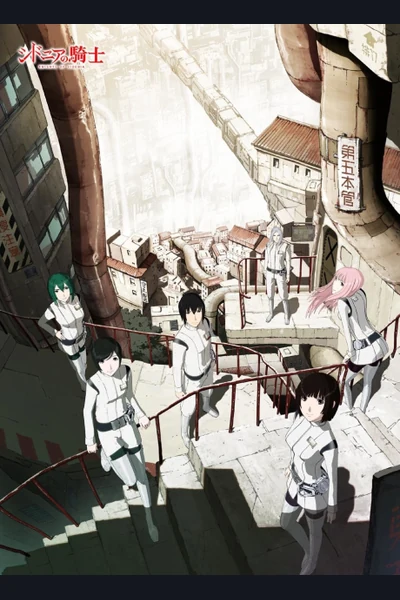
A thousand years after Earth was destroyed by the alien Gauna, humanity survives aboard the immense seed ship Sidonia. Nagate Tanikaze has spent his life hidden in its underground levels, training on an old guardian-pilot simulator. When hunger drives him to the surface, civilisation responds by placing him in the real machine. Career services remain brisk after the apocalypse.
Overview
Tsutomu Nihei's Knights of Sidonia combines generation-ship science fiction, military mecha and biological horror. Sidonia is not simply a battleship but a sealed society altered by necessity. Its people photosynthesise, reproduce through new arrangements and live beneath institutions that have survived longer than any reliable public memory.
The Gauna are vast, mutable organisms whose motives and bodies resist human categories. Pilots fight them in slender guardians using a rare weapon, while the ship's every evasive manoeuvre reminds thousands of civilians that inertia is not a theoretical concern.
Why it matters
Nihei excels at scale, architecture and lonely technology. Corridors dwarf their occupants; structures imply histories nobody pauses to explain. The manga brings that sensibility into a comparatively accessible story without making the universe feel domesticated.
It also imagines human adaptation rather than merely bolting contemporary society into a metal box. Izana Shinatose belongs to a third sex that develops in response to a chosen partner, while cloning and genetic engineering have become practical features of survival. The treatment is not always as exploratory as the ideas deserve, but the ideas are present.
What to expect
Expect claustrophobia, pilot deaths, body horror, mass-casualty danger and battles where victory can still resemble an industrial accident. There is also school comedy, romance and harem material whose broadness sometimes collides with the splendidly alien setting. A gravity emergency may be followed by an awkward bath gag; civilisation contains multitudes.
Nihei withholds explanation and trusts readers to infer. The anime is clearer, though its proper-noun barrage can still rattle the hull.
Adaptations and versions
The manga is complete. Polygon Pictures adapted it with three-dimensional computer animation across television series and a concluding film. The CG approach suits mechanical movement and the eerie similarity of engineered bodies, although facial acting takes time to acclimatise to.
The anime condenses and alters material on its route to an ending. Read the manga for Nihei's stark linework and full architecture; watch the screen version for spatial combat and an accessible complete course.
Where to start
The anime makes the terminology and action easiest to follow. Give its visual style several episodes before declaring an airlock emergency. The manga is the better first choice for readers already fond of Nihei's monumental spaces.
Verdict The SFcrowsnest take
Knights of Sidonia offers a genuinely strange human future rather than a naval drama with stars painted outside. Its romantic comedy can feel imported in the wrong shipping container, but the generation ship, Gauna and vertiginous battles are formidable. In space, nobody can hear the structural engineer asking why you ignored the mass limit.