
Gintama
Alien overlords have conquered a sci-fi Edo Japan, and a lazy, sugar-addicted samurai takes odd jobs to make rent; whiplash parody that swerves, without warning, into stunning drama.
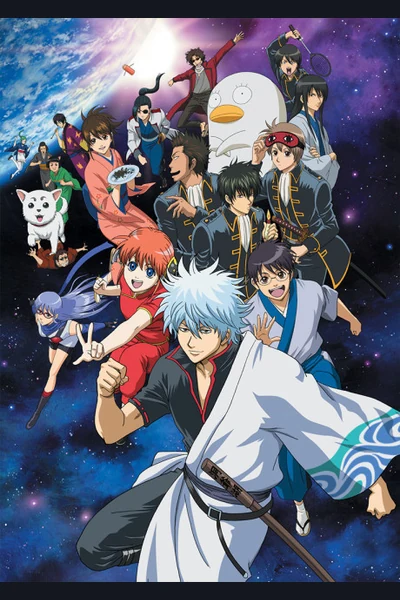
Aliens called Amanto have conquered an alternate Edo, banned swords and introduced advanced technology without improving rent. Former samurai Gintoki Sakata runs the Odd Jobs business with earnest Shinpachi Shimura and super-strong alien girl Kagura. They accept almost any work, complete it badly and remain solvent through accounting methods the shogunate has wisely declined to investigate.
Hideaki Sorachi's manga ran from 2003 to 2019, mostly in Shueisha's Weekly Shonen Jump, and filled 77 volumes. The anime began in 2006 under Sunrise and later Bandai Namco Pictures, accumulating hundreds of episodes, title variations, films and fake endings before eventually reaching a real one.
Overview
Most episodes parody manga, television, politics and the production itself. Characters complain about budgets, deadlines and popularity polls while inhabiting a story capable of switching into sword drama with almost no warning.
Gintoki's laziness conceals a past in the failed Joi rebellion. Friends Katsura and Takasugi carry different responses to defeat, while the Shinsengumi police supply rivals, allies and another workplace where adulthood has been postponed.
Why it matters
The comedy builds attachment through waste: arguments over food, broken equipment and references that may require cultural footnotes. When a serious arc arrives, the audience already knows how these people live when nobody is saving the country.
Sorachi's great trick is tonal trust. Toilet humour and grief do not cancel one another because the characters remain recognisable in both. The lesser trick is using enough toilet humour to make cancellation a practical sanitation issue.
What to expect
Expect parody, profanity, bodily jokes, violence, smoking and references to Japanese media that subtitles cannot always rescue. Gender and queer humour can be broad or dated, though the cast also repeatedly escapes simple categories.
Serious arcs include death, war and political violence. The transition can cause emotional whiplash; the programme has not offered compensation.
Adaptations and versions
The anime follows the manga while adding original jokes and production satire. Numbering becomes complicated across Gintama', Gintama°, Gintama. and later arcs. The Very Final film concludes the main story, preceded by The Semi-Final specials.
Earlier films include a retelling of the Benizakura arc and an original apparent finale. Consult a release-order list rather than trusting punctuation.
Where to start
Begin with anime episode three; the first two were a celebration for existing manga readers. Allow a dozen episodes for the ensemble to form. Manga volume one is cleaner for chronology but cannot reproduce the anime's voices and reckless copyright brinkmanship.
Verdict The SFcrowsnest take
Gintama is difficult to recommend neatly because neatness is one of its recurring enemies. It is puerile, emotionally astute and capable of spending twenty minutes on a broken toilet before delivering excellent samurai drama.
Persist and the odd jobs become a family. Bring a reference guide and disinfectant.