
Battle Angel Alita (Gunnm)
A scrapyard cyborg girl rebuilt by a kindly doctor turns out to be a lethal lost-martial-arts master; the cyberpunk classic Hollywood eventually turned into Alita: Battle Angel.
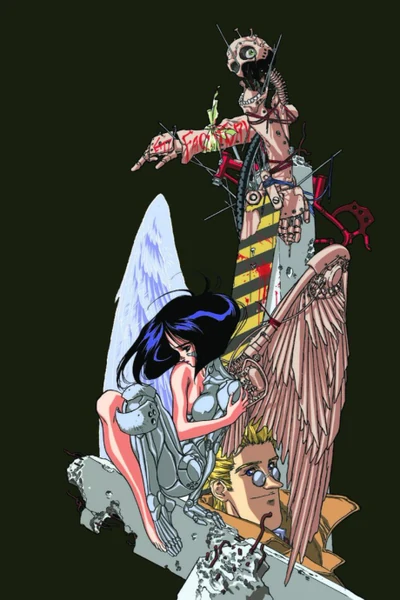
Cyberneticist Daisuke Ido finds a living head in the scrapyard beneath the floating city of Zalem. He gives her a body and the name Alita. She has no memory, enormous eyes and combat instincts suggesting her previous occupation involved fewer customer-satisfaction forms than his clinic.
Overview
Yukito Kishiro's manga is known as Gunnm in Japan and Battle Angel Alita in English. Its scrapyard city is a brutal ecosystem of bounty hunters, body modification and industrial waste, with Zalem hanging overhead as both heaven and landlord.
Alita's rediscovered Panzer Kunst martial art makes her exceptionally dangerous, but combat is only one method of self-definition. She tries work, love, competition and rebellion while asking whether identity lives in memory, brain, body or choices. The available answers grow less tidy as replacement bodies become tools, commodities and political statements.
Why it matters
The manga is a cyberpunk landmark because its philosophy has grease beneath the fingernails. Inequality is vertical and visible: privilege floats while the poor recycle its rubbish. Bodies are mutable, yet class power survives every upgrade.
Alita herself is neither detached machine nor standard action heroine. She is impulsive, tender, furious and capable of remaking herself without becoming invulnerable to loss. Kishiro's mechanical detail gives her violence weight; metal bends, breaks and costs money to repair.
What to expect
Expect dismemberment, brain imagery, blood, body horror, exploitation and a world where death can be both abrupt and technically complicated. Motorball and martial combat supply kinetic spectacle, but tragedy is a recurring neighbour.
The early manga carries some dated gender and class caricature, while later volumes broaden the science-fiction scale considerably. Alita's emotional volatility is a feature, not evidence that the cyborg warranty has failed.
Adaptations and versions
The original manga series is followed by Battle Angel Alita: Last Order and then Mars Chronicle. Publication history and revised continuity make the handover more complicated than a simple row of numbered shelves, so edition notes deserve attention.
The two-part 1993 animated adaptation covers only early material and alters characters. The 2019 live-action Alita: Battle Angel combines elements from the manga and OVA into another continuity. It is a handsome introduction, not a substitute for Kishiro's full story.
Where to start
Begin with volume one of the original manga under either English title. It supplies the foundation every later version selects from. The film is a welcoming visual sampler; the OVA is an interesting historical compression.
Verdict The SFcrowsnest take
Battle Angel Alita delivers the chrome and carnage cyberpunk promises, then asks what remains when the hardware has been replaced again. Its continuity can resemble a parts drawer after an earthquake, but Alita's search for self gives the machinery a pulse. Zalem floats; the story keeps its boots in the scrap.