
Dr. Stone
All humanity is turned to stone for 3,700 years; one science-mad teen wakes up and sets about rebuilding civilisation from first principles. A rare adventure where the superpower is the scientific method.
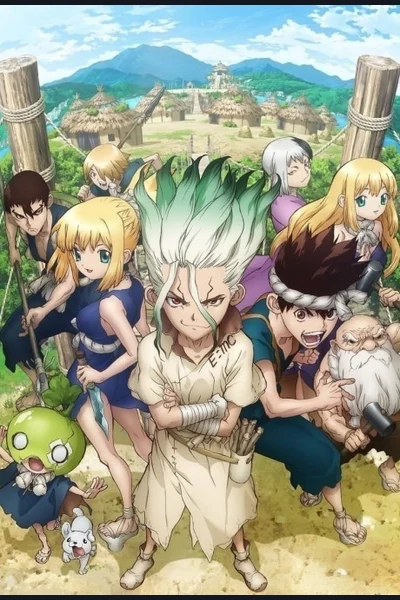
A green light turns every human on Earth to stone. Thousands of years later, teenage scientist Senku Ishigami awakens to wilderness and immediately begins counting, experimenting and planning the restoration of civilisation. Other survivors might first seek shelter. Senku would like nitric acid and a project timetable.
Overview
Riichiro Inagaki and artist Boichi build Dr. Stone around a rare battle-manga superpower: accumulated human knowledge. Senku cannot punch harder than his enemies, but he understands chemistry, physics, engineering and the vital motivational value of promising people ramen.
The Stone World turns technology into a quest tree. Soap, glass, electricity, antibiotics and communications each require raw materials, tools and specialists. What appears to be one genius's achievement gradually becomes a celebration of collective labour. Science advances because craftspeople, athletes, navigators and incorrigible showmen contribute what Senku cannot.
Why it matters
Popular adventure often treats technology as magic with a charging socket. Dr. Stone makes process the spectacle. Its most satisfying reveals are not mysterious weapons but familiar inventions reconstructed from first principles, reminding viewers that ordinary modern objects contain centuries of shared work.
The story also stages an ideological dispute over restoration. Should the old world, with all its inequality, return? The answers are broad, but the question gives the crafting montages social consequence.
What to expect
Expect exuberant explanations, scavenging, exploration, comedy and conflicts increasingly conducted with scientific tools. The manga's experiments simplify timescales and practical hazards, and some feats are cheerfully impossible. This is advocacy for curiosity, not an accredited laboratory manual. Eye protection remains disappointingly resistant to dramatic fashion.
There is violence and peril, though problem-solving usually outranks bloodshed. Boichi's landscapes and machinery are superb; his exaggerated, sexualised rendering of female characters is far less defensible and can make the visual tone lurch.
Adaptations and versions
The main manga is complete, offering Inagaki and Boichi's full journey. TMS Entertainment's anime follows the central story in a clear, accessible fashion, using sound and motion to sell both experiments and moments of discovery.
Additional manga material and specials exist, but newcomers need only distinguish the main numbered story from side projects. The anime divides its progress across seasons and a bridging special, so release order is the safe route.
Where to start
The anime is an inviting science demonstration with strong comic performances. Start with the manga for faster progress, Boichi's detailed machinery and a completed route. Both begin at the petrification; no preparatory coursework is required.
Verdict The SFcrowsnest take
Dr. Stone makes civilisation look less like a collection of gadgets than humanity's longest group assignment. It is loud, simplified and sincerely delighted by knowledge. Senku may claim to be ten billion per cent certain rather too often, but a hero who defeats despair with soap and arithmetic deserves laboratory privileges.