Who is Steven Erikson?
An archaeologist and anthropologist (the training shows on every page) who, with Ian C. Esslemont, built the Malazan world as a shared role-playing setting before converting it into the most demanding mainstream epic of its era: ten volumes of the Malazan Book of the Fallen, published at a book a year — a pace nobody at that scale has matched — with no concessions whatsoever to the entering reader. Gardens of the Moon famously drops you mid-continent, mid-war, mid-pantheon and lets you swim. The reward for those who do: three hundred thousand years of excavated history, gods with employment grievances, the Bridgeburners, the Chain of Dogs, and a running meditation on compassion amid atrocity that earns its term-paper reputation. Esslemont's own novels share the canon.
Why they matter
The Malazan Book of the Fallen is epic fantasy's most ambitious completed structure — the genre's standing answer to the question of how big, how deep and how uncompromising the form can go and still find a mass readership.
Essential books — and where to start
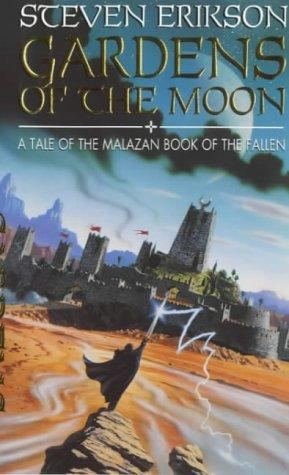
1999 · Malazan Book of the Fallen, book 1 · Fantasy · Epic Fantasy, Grimdark, Military SF
The Malazan Empire's siege of Pale opens with a mage-cadre annihilated from the sky and the floating fortress of Moon's Spawn withdrawing to Darujhistan, next city on the Empress's list — and that sentence is roughly as much orientation as Erikson provides. Sergeant Whiskeyjack's Bridgeburners, the possessed recruit Sorry, the Adjunct, the alchemist Baruk's cabal, Anomander Rake (Son of Darkness, dragon, owner of a soul-drinking sword that makes Stormbringer look like a letter-opener) and the gods — actively cheating — converge on the city in a structure that trusts the reader absolutely. Thousands of pages of payoff stand behind every unexplained term; the entry fee is this book, paid in full attention.
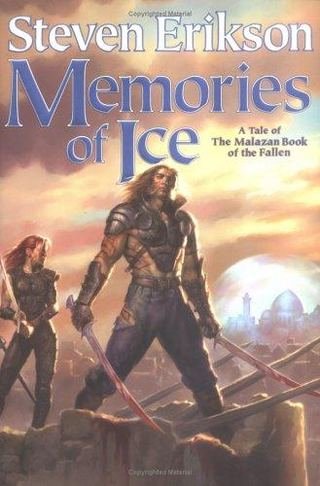
2001 · Malazan Book of the Fallen, book 3 · Fantasy · Epic Fantasy, Grimdark, Mythic Fantasy
The outlawed Malazan host of Dujek Onearm allies with yesterday's enemies — Caladan Brood, Rake, the Bridgeburners back in harness — against the Pannion Domin, a theocracy whose starving Tenescowri legions are weapon and atrocity at once, while beneath the war the crippled god's larger design surfaces and the K'Chain Che'Malle's dead machinery wakes. The siege of Capustan, the marines' chain of command under Itkovian's impossible grief-taking, the T'lan Imass at Silverfox's kettle: Erikson's great theme — compassion as the only counterweight to history's mass — states itself in full. The series' consensus masterpiece, and its most openly devastating volume.
Series
b. 1974 · British
The defining grimdark author after Martin: Abercrombie perfected the character-voice-driven, blackly comic register that dominates modern adult fantasy, and his fight scenes and moral hangovers are the subgenre's house style.
b. 1949 · American
Among the most awarded novelists in the field's history and the writer who proved space opera could be character-driven comedy of manners without losing its nerve.
b. 1944 · American
The founding document of military fantasy and grimdark's true ancestor: the Black Company's grunt's-eye view is the most influential perspective shift in post-Tolkien fantasy, acknowledged as bedrock by Erikson, Abercrombie and the entire dark-fantasy mainstream.
